

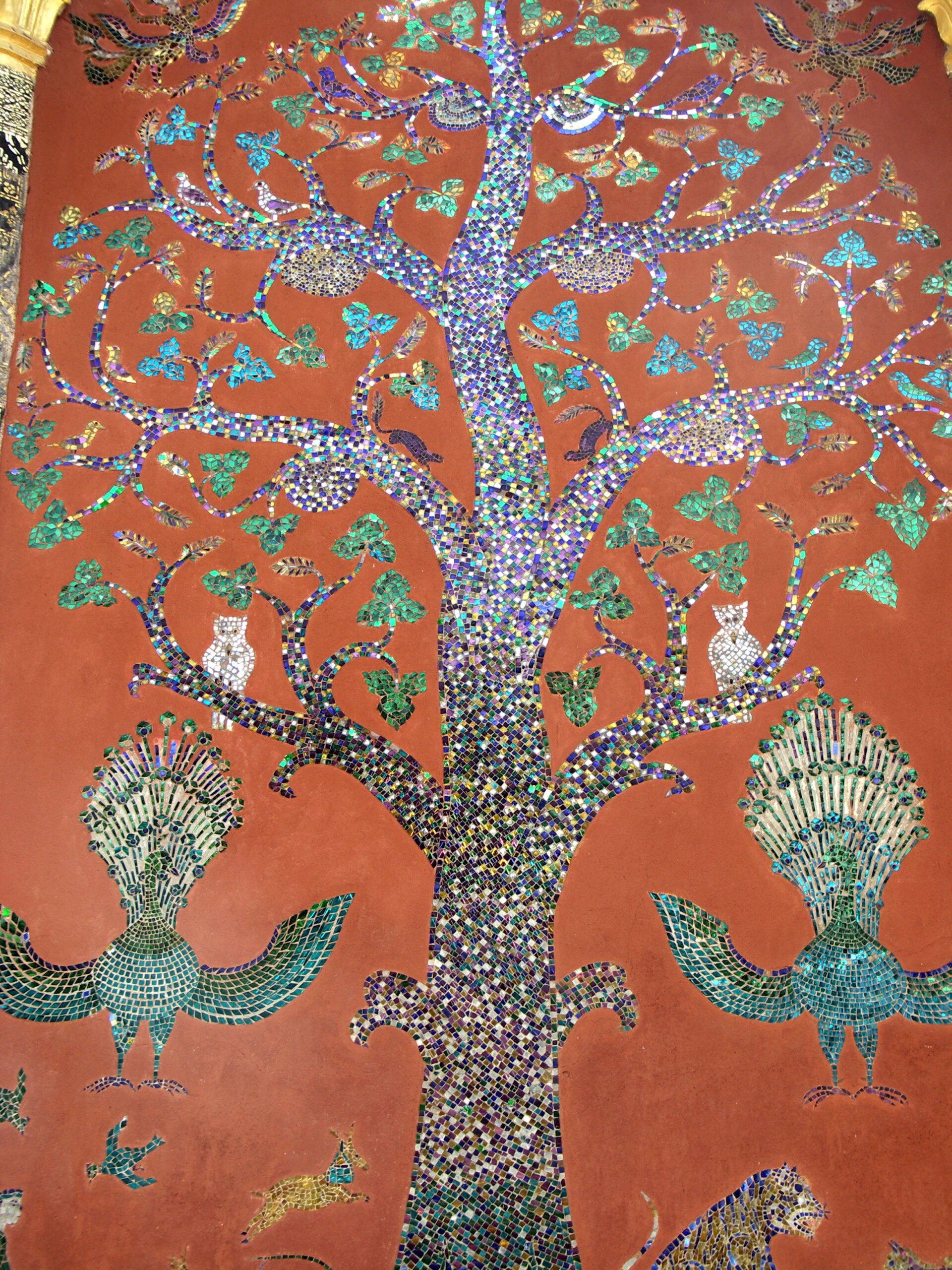
When you visit Wat Xieng Thong in Luang Prabang, take a moment to look up at the low sweep of its tiered roof, then walk around to the back of the main hall. A great tree spreads its branches across a deep red wall. Stand a little way off and what catches your eye is the shape of the tree. Come closer and you can make out a peacock in coloured glass. Once you have spotted one bird, your eye begins to follow the branches to see who else is there. [1]
A local legend tells of a flame-coloured tree that once stood here, where the Mekong and the Nam Khan meet. The Tree of Life we see today is said to depict that tree from the founding story of the royal city. The hall dates to the sixteenth century. The mosaic dates to the 1960s. A tree that people had kept alive in the telling for hundreds of years took shape again in coloured glass, in the hands of a generation of Lao craftspeople still within living memory. [1]
It is worth pausing over how much space this single tree occupies on a wall that tells of a city’s beginnings. Look long enough at the birds and animals gathered around it and you might begin to picture someone travelling the river long ago, steering by the sight of that same tree. Bird, beast and boat traveller each have their own relationship with a tree on a riverbank. To read the city’s art and history with those relationships in mind is to take what anthropologists call a multispecies perspective. Let’s carry that way of looking a little further into town.
A river guardian in a temple courtyard
Elsewhere in the grounds of Wat Xieng Thong, a gilded royal funeral carriage stands inside its own pavilion. At the front, seven naga heads rise in a row. The Lao sculptor Thit Tan carved these serpent deities, long associated with water. Remember those seven faces the next time you find yourself by the river. During Luang Prabang’s Festival of Lights, people set small offerings afloat, sending their prayers to the nagas and to their ancestors. A carving that accompanied a king on his final journey, a small light drifting away from someone’s hands. The same river guardian has a place in both. [2]
A kinnari has a human upper body and the wings and legs of a bird. A gajasimha combines a lion’s body with the features of an elephant. Southeast Asian temple art abounds in figures that bring several creatures together in a single body. Greek myth has its Sphinx, too, with a human face, wings and a lion’s body. On the road to Thebes she lay in wait for travellers with a riddle. What walks on four legs in the morning, two at noon and three in the evening? Here in Luang Prabang, one way to discover what an animal form is doing in a temple is to follow the water. [11]
At Wat Xieng Thong, look for the elephant’s head set with pieces of mirror on the outer wall of the main hall. At Lao New Year in April, worshippers pour water into a naga-shaped channel inside the hall. The water bathes a Buddha image, runs through a pipe beneath the floor and comes back into view at the elephant’s mouth. On an ordinary day you could look straight at the elephant’s face and never guess where the water comes from. Follow a drop and you can trace a whole rite, from the hands that pour water into the naga’s tail to those waiting to receive it outside. [12]
In Luang Prabang you may also see small shrines in temple grounds or outside people’s homes. Some are dedicated to the spirits who guard a place, known in Lao as phi. Someone who puts their palms together before the Buddha may also bring an offering to the spirit who watches over the place they live. A stretch of rapids, a hill, a great tree can each have a story that guides how people conduct themselves there. [3]
A king listens to a deer
Since I began working in tourism in Luang Prabang, local guides have taught me many of the stories depicted on temple walls. Many of the guides I work with lived in monasteries as novice monks until around the time they finished secondary school. When they show visitors around a temple, a single prince or animal on the wall can be all they need to begin a story.
Inside the main hall at Wat Xieng Thong, gold figures emerge from the dark walls. The artists used a stencilling technique called lai kham to tell a local story about King Chanthaphanith. Near the former Royal Palace, the golden walls of Wat Mai tell another story. Among the scenes of everyday life on the reliefs at the front of the hall is a prince named Vessantara. [4]
The prince is the Buddha in an earlier life. In the Theravada Buddhist tradition, the being who would become the Buddha was reborn many times. Over the course of those lives he cultivated qualities such as generosity and compassion for the suffering of others. The stories of those earlier lives are known as the Jatakas. [5, 10]
In Prince Vessantara’s kingdom lived a white elephant believed to bring rain. When envoys came from a neighbouring land stricken by drought and asked for the elephant, the prince gave it to them. His own people, whose fields and livelihoods depended just as urgently on rain, were furious. The prince went into exile in the forest with his wife and children. There, when asked, he gave up even his children. Only at the end of the story was the family reunited. The tale takes the Buddhist virtue of generosity, of giving without expecting anything in return, to its furthest extreme. Remember that it all began with an elephant on whom people depended for rain, and it makes sense to find the prince and the villagers sharing a wall at Wat Mai. [4, 10]
How does the story change when the Buddha is born as an animal? In the Ruru Deer Jataka, a golden deer hears the cries of a man being swept downriver. He carries the man to shore on his back and asks him to keep one thing secret — where the deer lives. In time, the king offers a reward to anyone who can find a golden deer. The man breaks his promise and leads the king into the forest. [5]
As the king draws his bow, the deer speaks. Who told him where to look? On hearing what happened, the king turns his anger on the man and means to kill him. Again the deer intervenes. He asks the king to spare the man and even to pay the reward he promised. The king agrees, pledges safety to the deer of his realm, and asks the golden deer to be his teacher. The deer has saved the same man twice. In the river he carried him to shore. In the forest he spoke up for his life. [5]
On the road to Thebes, Oedipus answered the Sphinx’s riddle and saved the city. His answer was a human being. A baby crawls on all fours, an adult walks on two legs, and in old age a walking stick makes a third. There is something precarious about that victory. Oedipus can recognise a human life from infancy to old age while still knowing so little of his own beginnings. The king who faces the golden deer also has his wisdom tested. He is sure the man deserves punishment until he hears the deer’s plea and lowers his bow. On the road to Thebes, a city’s fate turned on the answer Oedipus gave. In the forest, a man’s fate turned on a king’s willingness to listen to a deer and change his mind. [5, 11]
Whose knowledge counts when a forest is protected?
Walking through a World Heritage town, we ask the people who live there for directions, learn the names of temples from them and listen to the stories they tell about a place. Yet when our destination is a beautiful forest, how readily we reach for the word untouched. Where, in that word, is there room for the people who know which plants are edible, where water springs from the ground and what each tree is called?
Who draws the boundary of a protected area? How much say do the people who have long used that land have in the decision? Critics use the term green colonialism for forms of conservation in which outside organisations gain the power to make decisions while local people bear a disproportionate share of the cost.
What does that cost look like in an ordinary household? In northern Laos, researchers surveyed 255 households in eight villages in Nam Et–Phou Louey National Park. As it became harder to extend their upland fields, some farmers turned to growing rice in paddies. Opening a new paddy takes labour and money to level the land and dig irrigation channels. In another village, families sold their entire herds because they could no longer find enough land for grazing. A line drawn through the same forest could mean investing in a water channel for one family and parting with its livestock for another. [6]
Elsewhere in Laos, WWF-Laos supports riverside communities in managing their fisheries together. On the Xebanghieng River, four fish conservation zones established in 2024 each had their own management committee. Alongside setting stretches of river aside from fishing, a survey sought to find out which fish lived where by testing the water for traces of DNA. Local people who knew the river suggested the sampling sites. Community-led conservation can take a form as practical as this. The person who goes out on the river every day can point to a spot and say, “Try here,” and that changes where the research takes place. [7]
The world around one elephant
What are we trying to protect, and whose knowledge guides us? For many visitors to Luang Prabang, that question takes on a personal meaning when they consider an encounter with an elephant. The international organisation World Animal Protection encourages venues to move away from direct contact with tourists, including rides, and towards visits centred on observation, giving elephants more choice over what they do. Few of us would want an elephant to have to do something simply because we had come to see it. [8]
When the visitor takes a step back, the elephant’s day goes on. In Tai Lue villages in northwestern Laos, the anthropologist Nicolas Lainé asked mahouts, the people who care for elephants, about their animals’ health. The mahouts told him about the bark and roots their elephants sought out in the forest according to how they were feeling. They spoke of the forest as a kind of pharmacy where an elephant could look for what it needed. The elephant chooses which tree to approach and which part to eat. The person who has walked the same forest alongside that elephant can learn to recognise those choices and pass that knowledge on. [9]
If our wish to choose a place to visit responsibly comes down to a choice between “wild” and “exploited”, we risk losing the words to describe a relationship like this one. When an elephant’s way of life is about to change, do the people who know that animal day by day have a say in what should change and what is worth passing on? As travellers and tour operators who would like to see elephants better protected, how much responsibility are we willing to share for securing the land, meeting the costs and supporting the livelihoods of the people who will still be there to care for them?
Come back for a moment to the Tree of Life at Wat Xieng Thong. To find the peacock on that wall, it helps to stand close. Once you can see the bird clearly, take a few steps back. The branch it perches on joins the trunk, and beyond it you can see where another creature has made its home. Try looking that way at an elephant you meet in the forests of Luang Prabang. Where its trunk is reaching, there is a tree. Beside it stands someone who knows which branches this elephant likes.
Sources
- Northern Illinois University, Legend of the Founding of Xieng Dong-Xieng Thong.
- Luang Prabang Town and Environs Heritage Interpretation Plan.
- Northern Illinois University, Treasures of Luang Prabang — Beliefs.
- Tourism Luang Prabang, Wat Mai Suwannaphumaham.
- Ancient Buddhist Texts, The Birth Story about the King of the Ruru Deer.
- Joel Persson and colleagues, Large Differences in Livelihood Responses and Outcomes to Increased Conservation Enforcement in a Protected Area.
- WWF-Laos, Conservation Highlights, January–April 2024.
- World Animal Protection, Elephant-friendly tourist guide.
- Nicolas Lainé, Laotian Mahouts and Elephants — Glimpses into a Multispecies System of Medicine and Care.
- Ashmolean Museum, The Tale of Prince Vessantara. See also the Asian Art Museum’s account of the white elephant and the neighbouring kingdom.
- The Metropolitan Museum of Art, Oedipus and the Sphinx, and the Morgan Library & Museum, Study for Oedipus and the Sphinx.
- The Rough Guide to Laos, description of the ritual water channel at Wat Xieng Thong and a visitor’s account of the New Year water spout (in Japanese).
For the temple’s architecture and decoration, see Northern Illinois University’s Wat Xieng Thong.