Moral Reorganisation in Lao Elephant Tourism and Conservation
Introduction: From Moral Progress to Moral Reorganisation
A familiar global narrative presents the recent history of elephant tourism as a moral evolution from bad exploitation to good conservation: from logging, riding and close human control to rescue, non-contact tourism and rewilding. In Laos, however, this story obscures more than it explains. It turns a contested reorganisation of human–elephant life into a self-evident passage from an unethical past to an ethical future.
The central transformation examined in this chapter is therefore not a simple advance in morality, but a change in the object of care. Elephant Adventures sought to sustain a relationship among elephants, mahouts and regional communities whose material foundations were being weakened by the decline of logging and changes in rural life. The later Elephant Conservation Center (ECC) increasingly directed care towards the creation of more autonomous elephant social groups and, ultimately, the recovery of elephant wildness at a greater distance from humans. Both projects spoke in the language of conservation, but they did not seek to conserve the same thing: one cared for a historically formed multispecies relationship; the other increasingly cared for an autonomous elephant sociality oriented towards the wild. This reorientation is what the chapter calls elephant-centrism: not concern for elephants as such, but the elevation of the elephant as a separable moral and biological subject above the relations through which its life has been constituted.
This shift was reinforced by changes in the global elephant-tourism market. Transnational animal-protection campaigns, international tour operators and platforms such as TripAdvisor translated complex welfare questions into portable moral distinctions: riding or no riding, contact or no contact, exploitation or rescue. These pressures did not by themselves cause the transformation from Elephant Adventures to the ECC. They helped select and legitimise models that presented distance from humans as evidence of ethical progress, especially in predominantly Western travel markets.
The argument has four levels that should not be conflated. Elephant-centrism names the reorganisation of care around the elephant as a separable subject. The reputational market supplies one mechanism through which that reorganisation became commercially legible. The three paths described below are institutional responses to a shared crisis, not stages in a single evolution. Mannheim and Haraway then provide critical tests of the authority claimed by those responses. The chapter therefore offers a situated institutional genealogy rather than a complete causal history of Lao elephant conservation or a representative account of Lao opinion.
To analyse the different responses that emerged from this shared institutional lineage, the chapter distinguishes three paths within and around the ElefantAsia network. Gilles Maurer—an ElefantAsia co-founder who also participated in the institutional genealogy from which the ECC emerged, although he now works primarily as a researcher—treats elephants, mahouts, forests, labour and economic change as parts of one social-ecological system. Ingrid Suter’s welfare-centred approach assumes that human–elephant relations will continue and seeks to improve and standardise them through veterinary care, welfare assessment and professional reform. Sébastien Duffillot and the ECC increasingly organise intensive human care and mahout knowledge towards reherding, rewilding and greater elephant autonomy. These are not mutually exclusive schools or independent institutional biographies, but different answers to the question of what conservation should sustain, reform or eventually leave behind.
The chapter does not treat welfare science and biocultural critique as simple alternatives. It examines Suter’s reform programme and Lainé’s ethnography on their own terms, then analyses how marketing, reviews and platforms produce an ethical tourist gaze. The final section rereads the three paths through Mannheim’s sociology of knowledge and Haraway’s critique of disembodied objectivity, situated knowledge, response-ability, sympoiesis and “staying with the trouble.” The question is not only whether institutions measure welfare or preserve relations, but from what position they claim to know an elephant, whose interpretations retain authority and whether particular elephants and mahouts can alter the standards applied to them.
This chapter asks whether separation from humans should be accepted as the only legitimate endpoint of elephant ethics. It does not argue that rewilding is intrinsically misguided, or that every inherited form of human–elephant work should continue. Its normative claim is narrower: a reduction in human relations should not be treated as self-evident moral progress. The relevant questions are which relations enable or damage the life of a particular elephant, who remains responsible for that life, and what social and ecological capacities are sustained or displaced when conservation reorganises care.
The analysis that follows is written from a situated position within Lao tourism. Since 2018, the author has been responsible for sales, marketing and tour development at Manifa Travel and Manifa Elephant Camp, a Lao-owned company in Luang Prabang. By the time the author assumed this role, visits by Western tourists to the elephant camp had already been declining. Within the company, this decline was understood as closely connected to the growing rejection of elephant riding in Western travel markets discussed in this chapter. Rather than converting the camp into a sanctuary model, Manifa continued to offer riding, partly in response to the expectations of the Japanese visitors who had long supported it. Growth in Western markets was pursued instead through Manifa Travel’s wider portfolio of Luang Prabang tours and partnerships with online travel agencies. Revenue from these activities helped sustain an elephant-tourism operation that had become increasingly difficult to market internationally.
This strategy was not simply a failure to recognise changing consumer preferences. For a Lao-owned company, adopting the dominant rescue narrative would have required presenting historically formed relations among elephants, mahouts and local communities as conditions from which elephants needed to be saved. It would also have meant abandoning activities still valued by an established Japanese market. Although the welfare and economic future of the camp remained a continuing concern, neither conversion to a Western-facing sanctuary nor the unmodified continuation of the inherited riding model provided a satisfactory framework for reform.
During the interruption of tourism caused by COVID-19, the author’s reading of Donna Haraway prompted a search for another way of conceptualising elephant tourism: one that neither treated inherited relations as innocent nor assumed that ethical progress required their abolition. The author’s previous training in sociology made this relational perspective less alien than the sanctuary narrative, but there was no readily available equivalent within elephant tourism from which to construct a practical model. The present chapter grew from that practical and theoretical impasse. It is intended as a preliminary and diagnostic study for a future conception of elephant tourism, reconstructing the history through which the impasse emerged before attempting to prescribe an institutional alternative. The author’s professional position provides practical knowledge of tourism distribution and camp management, but it also shapes the questions asked here. The notes therefore distinguish, wherever possible, between archival documentation, published research, institutional self-representation and knowledge derived from the author’s direct involvement.
The chapter reconstructs the making of elephant-centrism by following the development of Elephant Adventures, the wider activities of ElefantAsia and the emergence of the ECC. It then examines welfare campaigns, welfare science and audit, followed by Lainé’s biocultural criticism, an analysis of the ethical tourist gaze and a final theoretical synthesis through Haraway. The analysis begins with a caravan that set out from Hongsa in 2007, when travelling with elephants and mahouts through villages and forests could still be presented not as the opposite of conservation, but as one possible form of it.
From Hongsa to the Mekong: Elephant Adventures in 2007
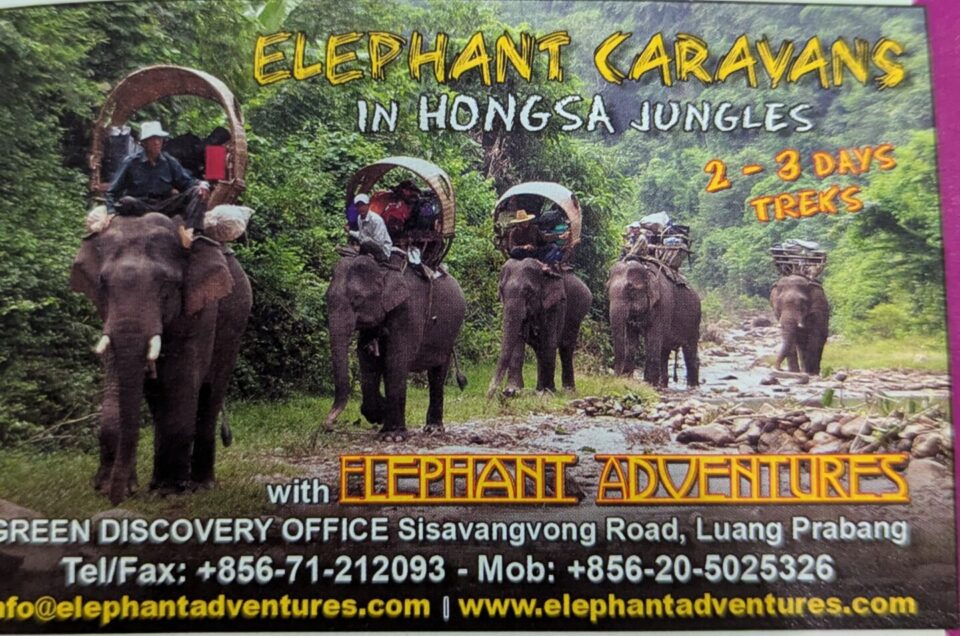
In 2007, a small-scale elephant caravan called Elephant Adventures began operating in Hongsa, northwestern Laos.
Travellers arrived from Luang Prabang or Pak Beng by boat, following the Mekong to Tha Souang before continuing overland to Hongsa. The following morning, near Sibounheuang village, each guest met an elephant and its mahout and set out on a journey of several days through villages, rice fields, river valleys and forests.
The caravan passed through Ban Then, crossed the Nam Tap River and continued to Ban Nam Tap. On arrival, the elephants were taken to the river and then released into the forest for the night. The next morning, guests could accompany the mahouts to retrieve the elephants, groom them and take them to bathe. On a steep uphill section, everyone travelled on foot. Farther along the route, the group visited a small, non-industrial logging site, where mahouts demonstrated how elephants could move timber. The journey then followed the Nam En River to a small Khmu village before reaching Ban Kheng En and the Mekong.[1]
This was not a short ride around a fixed elephant camp. It combined travel by boat, vehicle, foot and elephant, crossing a lived landscape over several days.
A map published with the Green Discovery itinerary shows the Hongsa basin, villages, rivers, mountain ridges, existing roads, forest trails and the Mekong as parts of a single journey. Roads were already present and were used for supplies and emergency access. Yet substantial portions of the route depended upon forest paths and on mahouts who knew where elephants could walk, drink, forage and rest.[2]
Figure 3.1. The Elephant Adventures caravan route, c. 2007–2008
Travellers entered Hongsa overland from Tha Souang. From the Hongsa area, the caravan crossed Ban Then, Ban Nam Tap, the Nam En watershed and Ban Kheng En before reaching the Mekong. Rather than operating within a fixed elephant facility, the journey connected elephants, mahouts, villages, forests and rivers across a regional landscape.
Looking at this itinerary today, many people would focus immediately on the fact that tourists rode elephants. This chapter asks a different set of questions.
Why was such a journey conceived as a conservation activity?
Why did it disappear?
And why did the same ElefantAsia network later produce the Elephant Conservation Center, an institution that increasingly placed reherding and rewilding at the centre of its mission?
Following this transformation reveals that the making of elephant-centrism in Laos was not a simple story of moral progress from exploitation to protection.
1. Beyond the Thai model of occupational transition
Accounts of elephant tourism in Southeast Asia are often organised around the experience of Thailand.
In January 1989, the Thai government imposed a national ban on logging in natural forests. Large numbers of elephants and mahouts subsequently entered an already expanding tourism sector. Elephant camps became widespread, offering activities that ranged from performances and riding to bathing, feeding and observation.[3]
The Lao trajectory was different.
In the early 2000s, international tourism in Laos—especially in Luang Prabang—was still in the process of becoming established. Lao elephant tourism therefore cannot be understood simply as the transfer of elephants displaced from logging into an already mature tourism industry. Rather, it emerged while Laos itself was being shaped as a new international destination, drawing upon the forest and village landscapes in which elephants and mahouts had long lived and worked.
Some of the earliest camps around Luang Prabang were established not in spaces created solely for animal display, but within river-and-forest landscapes that retained local memories of elephants. Tiger Trail’s Elephant & Adventure Camp at Ban Xieng Lom (later Elephant Village) and Manifa Elephant Camp, like Elephant Adventures, drew upon landscapes in which keeping elephants near water and forest was locally intelligible.[4]
These projects were not identical. Yet all emerged in relation to a shared set of problems: declining opportunities in forestry, the livelihoods of elephant owners, mahout employment, veterinary access, low reproduction and the uncertain economic future of domesticated elephants.
Here and throughout this chapter, domesticated elephant follows a term widely used in the Lao elephant sector for elephants living under individual or institutional human management. It does not imply that the Asian elephant has undergone domestication at the species level. Where appropriate, village elephant and captive elephant identify more specific social and institutional situations.
ElefantAsia’s own retrospective account states that its founders developed an ecotourism elephant-riding itinerary in 2007 and proposed it to Green Discovery, which marketed it under the name Elephant Adventures. The stated objectives included replacing more exhausting logging work, sustaining mahout traditions, supporting local development and financing elephant conservation.[5]
Understanding elephant tourism in Laos therefore requires more than an account of occupational transition from logging to tourism.
It requires an account of how landscapes once shared by people and elephants were reorganised through tourism, industrial development and conservation science.
2. Hongsa and Muang Thong: two elephant regions, two futures
Northwestern Laos had at least two important centres of domesticated-elephant culture: Hongsa and the area known locally as Muang Thong, officially Thongmixay District, adjoining the Nam Phouy National Biodiversity Conservation Area.
Hongsa: the loss of a mobile landscape
Hongsa once supported a substantial population of domesticated elephants, elephant owners and highly experienced mahouts. The elephants did not remain permanently at logging sites. They moved between villages, agricultural land, forests, rivers and places of work. When not working, many spent extended periods foraging in the forest.
Elephant Adventures did not introduce an entirely new elephant culture to Hongsa. It reorganised existing practices of mobility, forest use, mahout knowledge and village hospitality as a small-scale form of international tourism.
Yet the project emerged as Hongsa was approaching profound transformation. Hongsa Power Company was formed in 2009 to develop a 1,878-megawatt lignite mine-mouth power station. The project incorporated the mine and power plant together with roads, water infrastructure, transmission facilities and resettlement areas.[6]
The power project was not necessarily the sole cause of the decline in elephant keeping. Broader changes in forestry, employment, agriculture, transportation and land use also mattered. Local accounts nevertheless describe elephants leaving Hongsa for tourism businesses elsewhere in Laos and for foreign destinations, while some mahouts entered different occupations.[7]
When elephants leave, more than a numerical population is lost. A caravan such as Elephant Adventures required:
compatible elephant–mahout teams
a chief mahout able to select and coordinate them
knowledge of water, forage and resting places
relations with villages along the route
the ability to release elephants safely into forest overnight; and
the collective experience needed to respond when terrain, weather or an individual elephant required a change of plan.
Roads also changed the meaning of the journey.
The Elephant Adventures map shows that roads were never entirely absent. Vehicles carried visitors from Tha Souang to Hongsa, delivered supplies to Ban Nam Tap for larger groups and provided an emergency evacuation route. Initially, roads supported the caravan as secondary infrastructure.
As roads expanded, however, they also enabled agricultural conversion, settlement, commercial transport and more intensive access to previously remote areas. A trail could remain physically open while becoming unsuitable for elephants because of crops, fences, traffic, land claims or the disappearance of forest where the animals could forage and rest.
For Elephant Adventures, remoteness was not simply an obstacle. It was part of the journey’s substance. The fact that a route could not be travelled quickly by vehicle—and that mahouts knew how to cross it with elephants—was precisely what gave the journey its form.
Roads brought Hongsa closer to the outside world. At the same time, they helped erase the Hongsa that Elephant Adventures had turned into a journey.
Muang Thong: what access to forest made possible
Muang Thong followed a different path and continues to retain a significant population of domesticated elephants.
This cannot be explained merely by suggesting that its residents valued tradition more strongly. The decisive material condition was its proximity to the extensive forests of Nam Phouy.
Research by Gilles Maurer and his colleagues describes Thongmixay as an area where village elephants could still be released seasonally into forest, forage with a degree of autonomy and encounter wild elephants. The authors interpret the older system not as complete confinement but as a form of elephant keeping characterised by common access to forest resources, intermittent human supervision and seasonal freedom. They also document how agricultural intensification, divided land access and tighter protected-area boundaries have placed this system under increasing pressure.[8]
Around Nam Phouy, domesticated females have encountered and mated with wild bulls. Maurer and his co-authors consequently argue that the wild and domesticated populations cannot be understood as wholly separate demographic systems. The reproduction of village elephants has depended partly on access to wild males, while the survival of domesticated elephants has also been shaped by the economic decisions of their human owners.[9]
Human beings, domesticated elephants, wild elephants, forest, labour, ownership and reproduction therefore formed a single social-ecological system.
The contrast between Hongsa and Muang Thong is significant:
In Hongsa, the landscape that sustained elephant culture was industrialised and reorganised. In Muang Thong, the forests of Nam Phouy preserved much of the physical space in which relations among people, village elephants and wild elephants could continue.
This does not mean that the protected-area system was created to preserve domesticated elephants. Nor does it mean that formal conservation rules have always supported village access.
If the protected area had been completely closed to local people and village elephants, the social-ecological system described by Maurer could not have persisted. What mattered was both the survival of a large forest block and the continued porosity of its boundaries.
Muang Thong maintained elephants not by separating them completely from people, but because access to forest still made a continuing human–elephant relationship materially possible.
3. ElefantAsia: respect for culture and the impulse to enlighten
Two tendencies coexisted in the early work of ElefantAsia.
The first was relational and biocultural. It sought to protect elephants together with mahouts and the social worlds in which they lived.
Elephant Adventures described elephants as part of Laos’s cultural heritage. Travellers were invited to learn about mahout life, travel between villages and forests and contribute to the continuation of both elephant and mahout culture. In its 2007 French-language publicity, Hongsa was described as a sanctuaire des derniers éléphants domestiques du pays—a sanctuary of the country’s last domesticated elephants.[10]
At that time, sanctuary did not necessarily mean a facility in which elephants were removed from human relations. It referred to a region in which elephants, mahouts and their shared culture still survived.
The second tendency was modernising and managerial. It sought to improve local practices through Western veterinary medicine, international development programmes, formal training, standardised records and institutional management.
Elephant Adventures contributed five per cent of its turnover to ElefantAsia’s mobile veterinary programme. In cooperation with the Lao National Animal Health Centre, ElefantAsia trained veterinary personnel, operated a mobile clinic, distributed first-aid materials and created a national registration database. Between December 2007 and July 2009, the Mobile Veterinary Unit recorded treatment of 347 domesticated elephants, most of them working in logging.[11]
These interventions had substantial practical value. Laos had very limited specialist veterinary capacity, medicines were difficult to obtain in remote districts, and injuries and chronic conditions associated with forestry were often untreated.
Yet the programme also institutionalised a hierarchy of knowledge.
Nicolas Lainé observed that Western veterinary medicine was used mainly for elephants working in tourism facilities, while mahouts in neighbouring villages were often reluctant to consult veterinarians even when ElefantAsia provided treatment free of charge. Some village mahouts instead emphasised forest access, rest and elephants’ own selection of medicinal or restorative plants.[12]
This reluctance should not be understood simply as ignorance.
Western veterinary medicine tends to identify symptoms, diagnose a condition, administer treatment and document the progress of an individual body. Village elephant care may also consider workload, season, forest release, plant selection, individual temperament, human–elephant history and ritual or spiritual relations.
Free medical treatment removes a financial obstacle. It does not resolve questions of authority:
Who defines illness?
Who knows the elephant best?
Which forms of knowledge become institutionally legitimate?
The Mobile Veterinary Unit’s own published report reflects this tension. It valued mahouts’ daily role and employed a multilingual liaison officer, but it also described some mahouts as lacking understanding of preventive medicine and framed external education as the remedy. Information from Thai elephant-care manuals and international veterinary literature was translated and transferred into Laos.[13]
ElefantAsia therefore spoke of respecting mahout culture while simultaneously treating that culture as something that needed to be trained, corrected and modernised.
This was not simply cultural rejection. It was a form of developmentalism that included local culture while retaining external authority over what counted as improvement.
A corresponding form of saviourism was already possible within this model. The narrative was not yet “rescuing elephants from Lao people.” It was closer to rescuing both elephants and mahout culture from decline through foreign expertise, conservation funding, veterinary science and international tourism.
The coexistence of relational commitment and managerial intervention within ElefantAsia is important for the argument that follows. It helps explain how the same institutional network could later generate social-ecological research into human–elephant interdependence, welfare programmes designed to reform and standardise that relationship, and the ECC’s attempt to reorganise it towards greater elephant autonomy. The three paths outlined in the introduction were later developments of tensions already present in ElefantAsia’s early practice.
4. Elephant Adventures: a mobile conservation economy
Elephant Adventures was designed and promoted not simply as an elephant-riding business, but as a conservation-oriented tourism project.
Green Discovery’s operational documentation describes a carefully structured, high-cost and low-volume product.
Groups were limited to six guests. In principle, each traveller was assigned one elephant and one mahout. A chief mahout, local guide and cooks also accompanied the caravan. For groups of one or two guests, an additional elephant carried camping and kitchen equipment. For groups of three or more, supplies were delivered by vehicle to Ban Nam Tap rather than continually increasing the load carried by the elephants.[14]
Participating elephants and mahouts were selected by the chief mahout. The documentation emphasised reliable commands, experienced elephant–mahout teams, safety instruction and knowledge of the forest. Green Discovery described the project as converting logging elephants into “quality and humane ecotourism activities.” It also stated that host villages were paid according to arrangements defined with villagers.[15]
The programme was explicitly marketed as upmarket. In 2007, the five-day tour cost US$990 per person for two participants, US$700 for three or four participants and US$600 for five or six. The intended customers were travellers prepared to accept basic accommodation and difficult terrain in return for an extended journey with elephants and mahouts.[16]
The project attempted to create a mobile conservation economy.
Tourism revenue would employ mahouts.
Villages would earn income.
Logging elephants would move into work that was presented as less exhausting.
Veterinary treatment and reproduction programmes would receive funding.
Travellers would learn from mahouts.
Later Elephant Adventures material stated that mahouts were paid more than they had earned in logging. When the elephants and mahouts needed two additional days to return to Hongsa without tourists, they received the same daily payment. Village funds also received contributions for each guest-night, while five per cent of total turnover went to the Mobile Elephant Clinic.[17]
The project’s stated object of conservation was therefore not the elephant’s body in isolation. It was a mobile relationship connecting elephants, mahouts, families, villages, forests, rivers and visitors.
This should not be romanticised as the untouched survival of traditional culture.
Guests received a “Basic Mahout Course Certificate.” They were tested on commands in a village courtyard. Logging skills were demonstrated for visitors. At the end of the journey, the elephants were reportedly brought to the riverbank to kneel as the guests departed.
These were forms of tourism staging. Regional practices were selected, arranged and made legible to an international audience.
Elephant Adventures consequently had a dual character:
It was a biocultural journey grounded in living mahout knowledge and regional landscapes, but it was also a commercial product that packaged those relations for the international tourism market.
Commercialisation does not necessarily make a relationship false. Nor does the presence of local culture make a tourism activity automatically responsible.
The relevant questions concern who designed the product, whose knowledge carried authority, how revenue was distributed and what kinds of lives the elephants were able to lead.
The distinction drawn here is therefore not between an authentic, non-commercial tradition and a corrupted commercial modernity. Elephant Adventures, the ECC and welfare-certified tourism are all market-mediated arrangements. The analytical issue is what each arrangement uses revenue, land and institutional authority to reproduce: continuing capacities for a shared human–elephant life, a reformed and auditable working relationship, or an elephant sociality increasingly organised apart from humans. Commercial staging becomes consequential when it redistributes authority or changes the object that institutions undertake to sustain.
5. Was Elephant Adventures intended as a permanent model?
It remains uncertain whether Elephant Adventures was conceived as a permanent means of sustaining Hongsa’s elephant culture.
Several possibilities remain open.
It may have been intended as a long-term community-based tourism model.
It may have been conceived as temporary employment for elephants and mahouts affected by declining forestry and the approaching transformation of Hongsa.
It may also have functioned as a transitional project while ElefantAsia prepared a more permanent, concentrated facility at Nam Tien.
The available evidence establishes that both models were being considered during the same period. A 2010 article written by ElefantAsia staff described elephant trekking in Laos as still being in its infancy while stating that an ElefantAsia-sponsored “sanctuary” was about to open. The article was based on veterinary data collected between 2007 and 2009, during the period when Elephant Adventures was being actively promoted.[18]
This demonstrates concurrent planning. It does not prove that Elephant Adventures was deliberately designed from the outset as a short-lived bridge to the ECC.
The project received substantial investment. It had a dedicated website, international media coverage, books, films, promotional materials and distribution through Green Discovery. Elephant Adventures was still advertising future caravan departures on its website in 2011. Some Green Discovery pages remained archived through February 2014, although the persistence of an online page does not establish that tours were still being operated at that date.[19]
Nevertheless, the model was structurally fragile.
It required several compatible elephant–mahout teams, a capable chief mahout, enduring relations with villages, knowledge of a long route, camping and food logistics, access to forest and an international sales network able to sell an expensive specialist journey.
When elephants and mahouts left the region, the problem was not merely that there were fewer animals available. The collective capacity to organise the caravan was progressively lost.
When forests became farms, roads or industrial areas, routes might remain geographically traceable while becoming socially unsuitable for elephants. The journey depended on access to water, forage, rest areas and forest where elephants could stay overnight without damaging crops or creating conflict.
The disappearance of Elephant Adventures probably resulted from at least two overlapping processes.
First, changes in elephants, mahout employment and landscape access around Hongsa made the tour increasingly difficult to operate.
Second, growing criticism of elephant riding in Western travel markets made it increasingly difficult to sell, defend and reinvest in.
At present, the chronology of the second process requires further research. Booking records, Green Discovery correspondence, tour-operator policies and interviews with former staff would be needed to establish when anti-riding pressure became commercially decisive.
Changing international ethics did not necessarily create the original material crisis. They may, however, have made it far harder to reconstruct a model that was already losing its regional foundations.
The operational base weakened first; the changing moral market then reduced the possibility of rebuilding it.
The evidence is uneven, and that unevenness limits the comparison that follows. Elephant Adventures can be reconstructed from unusually detailed itineraries, logistics documents and promotional archives, but not from complete booking records or a sustained ethnography of its operation. The ECC is more visible through its present institutional publications, scientific partnerships and visitor discourse, but its internal labour relations, financial structure and everyday negotiations with mahouts are not documented here to the same depth. The chapter therefore compares changing public and institutional objects of conservation; it does not claim to provide a symmetrical ethnography of daily life at both projects or a comparative assessment of the welfare of their elephants.
6. From dispersed relations to concentrated conservation
The Elephant Conservation Center did not suddenly appear as an external sanctuary opposed to elephant tourism.
It emerged from the same network of veterinary care, reproduction programmes, mahout training and ecotourism development associated with ElefantAsia.
According to the ECC’s official history, the organisation was registered in Sayaboury Province in 2010. It was established at Nam Tien with an elephant hospital and a land concession intended to support breeding and socialisation. The ECC then began purchasing elephants from owners who had decided to sell. Its official account explicitly connects the centre’s creation to declining logging opportunities and the effort to redirect mahouts towards ecotourism.[20]
The ECC and Elephant Adventures therefore represented two different spatial arrangements of conservation.
The difference was political-ecological as well as spatial. It concerned who owned elephants, who controlled access to land, who employed mahouts, which institutions attracted international finance and whose knowledge could authoritatively define conservation.
Elephant Adventures was a dispersed model: it connected elephants still owned in villages, mahouts, local hosts, shared forests, rivers and existing travel routes. The ECC was a concentrated model: it brought elephants into a dedicated territory governed by an organisation with veterinary facilities, paid staff, breeding plans, land rights, scientific partners and access to international funding.
The first model depended on the continued viability of a regional social landscape. The second could continue even when elephant keeping in the surrounding region was declining, provided that the institution retained land, revenue and administrative capacity.
This was a practical adaptation. Where families could no longer maintain elephants, moving the animals to a dedicated centre could appear to be the most realistic way to provide land, food, medical care and long-term management.
Yet the solution also changed the elephants’ social position.
An elephant that had been family property, a participant in village life and a mobile presence in a regional landscape could become an individual protected and managed by a specialised institution.
The mahout could shift from owner, relative or locally embedded practitioner to employee within an organisational hierarchy.
The forest was increasingly redefined from a lived and shared space used by villagers and elephants into a conservation territory governed through institutional agreements.
The ECC was designed to protect elephants from the collapse of regional elephant-keeping systems. It was also made possible by transferring elephants out of those systems.
This is not a contradiction that can be resolved simply by deciding whether the ECC is good or bad. It is the central dilemma of its institutional formation.
7. How the object of conservation changed
A comparison between Elephant Adventures and the later ECC reveals a transformation not only in the language of conservation, but in its moral and practical object.
The earlier vocabulary emphasised:
elephants and mahouts
the “Way of the Mahout”
cultural heritage
village hospitality
forest journeys
humane ecotourism
local development
veterinary care; and
economic alternatives to logging.
The crisis was defined as declining forestry employment, inadequate veterinary care, low reproduction and the disappearance of mahout culture.
The proposed solution was to relocate human–elephant relations within a different economy.
In its contemporary public presentation, the ECC increasingly emphasises:
rescue
rehabilitation
natural behaviour
socialisation
reherding
rewilding
release; and
recovery of wild populations.
The centre describes the creation of socially compatible elephant groups as preparation for eventual release into Nam Pouy. Mahouts continue to contribute their knowledge to this process, while released elephants remain subject to observation, GPS tracking and ranger patrols.[21]
This was not merely a change in terminology.
In the earlier model, sustaining a continuing human–elephant relationship was itself a conservation objective.
In the later model, that relationship increasingly became a means of preparing elephants for greater social autonomy and reduced human dependence.
The change should not be depicted as completely linear. The ECC continues to employ mahouts, acknowledges their expertise and depends on direct human intervention in veterinary treatment, breeding, socialisation and rewilding.
Indeed, the ECC’s own description of rewilding makes the continuing relationship visible. Former mahouts track released elephants; mahout knowledge is described as essential; government agencies, rangers, biologists, donors and technology all remain involved.[22]
The ECC’s defining tension is therefore not that it has eliminated human–elephant relations.
It is that:
Operationally, the ECC remains deeply relational, while institutionally its preferred future is directed towards increasing separation and wildness.
Rewilding is not the absence of human–elephant work. It is a new and highly organised form of that work.
This structure is not unique to the ECC. Conservation translocations generally require intensive human selection, veterinary preparation, acclimatisation, monitoring and post-release management in order to establish animals that can live with less routine human support. In the case of Asian elephants, the IUCN/SSC Asian Elephant Specialist Group’s 2024 guidelines explicitly treat mahouts, veterinarians, biologists, rangers, government agencies and local communities as necessary participants in rehabilitation and release. They also require planners to assess the effects of removing elephants from owners and mahouts who may have strong bonds with them, and to consider risks and benefits from the perspectives of elephants, people and landscapes.[23]
The mere fact that rewilding uses human care to reduce later human dependence is therefore not, by itself, a contradiction. Minimal contact may be a defensible technical objective for displaced wild calves or other elephants selected for release. The question specific to the Lao case is more demanding: when elephants have been formed through long relations with mahouts, households and working landscapes, on what grounds should those relations be treated only as conditions to be overcome? Rewilding should be evaluated as one possible conservation strategy for particular elephants and recipient landscapes, not elevated into the universal moral completion of elephant care.
8. From welfare campaigns to an activity-based moral market
From the 2000s onward, the international language used to evaluate elephant tourism also changed.
Rosaleen Duffy and Lorraine Moore argued that animal-welfare organisations had become influential actors in the global governance of elephant tourism. They also warned that universal standards could reproduce North–South power inequalities when they failed to engage seriously with local practices and economic conditions.[24]
The campaigns addressed management conditions with genuine welfare relevance, including prolonged restraint, hard substrates, limited social opportunities, nutritionally unbalanced diets and inadequate veterinary care. The analytical question is not whether such conditions matter, but how evidence about variable conditions at particular venues became translated into categorical judgements about tourist activities everywhere.
World Animal Protection’s 2017 report Taken for a Ride was especially influential. Based on visits to 220 venues in six Asian countries, including Laos, it documented the conditions of 2,923 elephants and reported that three quarters were living under poor or unacceptable conditions. All elephants in the lowest-scoring group were kept at venues offering riding, while the highest-scoring venues offered no riding or performances and generally restricted direct tourist contact.[25]
The report’s evidentiary contribution and its methodological limits must be distinguished. Its rapid welfare-conditions assessment recorded such factors as restraint, shelter, hygiene, diet, social interaction, daily routines, management and tourist activities. It was designed to identify broad institutional conditions across a very large number of venues. The report explicitly acknowledged, however, that it did not directly measure the welfare state of individual elephants. It assessed the conditions presumed to affect welfare and converted them into a single score for each venue.[25]
This distinction became less visible as the findings moved from assessment into campaigning. A correlation between riding venues and poor conditions was increasingly translated into the stronger claim that riding, training or direct tourist contact was itself reliable evidence that an elephant had been subjected to cruelty. WAP’s campaign materials presented “wildlife entertainment” as a category to be phased out and promoted observation-only sanctuaries and viewing elephants in the wild as the principal ethical alternatives. Its normative premise—“wild animals belong in the wild, not in entertainment”—preceded and exceeded the narrower empirical question of how particular management practices affected the welfare of particular elephants.[25]
International discussion consequently came to rely increasingly on visible moral oppositions:
riding versus no riding
touching versus no touching
bathing versus no bathing
captivity versus freedom
camp versus sanctuary.
Within this framework, the most visible tourist activity can become more important than the elephant’s overall life.
A photograph of riding may be treated as sufficient evidence of an institution’s ethics before anyone investigates the duration and conditions of the activity, the elephant’s health, forest access, exercise, diet, social environment, veterinary records or relationship with its mahout.
What subsequent welfare research showed
Research conducted subsequently by Chiang Mai University, the Smithsonian Conservation Biology Institute and their collaborators did not support the use of a simple activity label as a proxy for welfare. A major review concluded that claims of universal brutality in elephant tourism were often based on anecdote rather than solid science, that management varied substantially among camps and that not all tourist activities were necessarily detrimental. Welfare, the authors argued, should be evaluated through objective physical, physiological and psychological evidence.[26]
Studies of individual elephants produced results that complicated the riding/no-riding distinction. At five camps with different management systems, elephants at an observation-only venue had some of the highest body-condition, insulin and glucose measures and poorer metabolic profiles than elephants receiving exercise through riding programmes. Across camps, greater walking distance and work time were associated with healthier metabolic measures, while tourist numbers and the provision of bananas, sugar cane and other supplementary foods were associated with higher body condition and less favourable metabolic indicators. The authors did not argue that riding was inherently beneficial. They concluded that hands-off facilities must still ensure adequate exercise and appropriate diets.[27]
A separate study of 122 elephants at fifteen camps found that saddle-related wounds were rare. By contrast, excessive body condition, hard substrates and the improper use of control equipment emerged as identifiable concerns. Approximately one quarter of elephants whose mahouts carried an ankus showed wounds in areas where the tool could be applied. The relevant welfare issue was therefore not the mere visibility of a saddle or ankus but the conditions and manner in which equipment was used.[28]
Another year-long comparison of elephants in saddle-riding, bareback-riding and no-riding programmes found no clear indication that riding per se negatively affected the two physiological markers examined. Overall faecal glucocorticoid metabolite concentrations were lowest in the saddle-riding group, although results varied among camps, biomarkers and sample types. The researchers cautioned that chaining, inappropriate ankus use and limited social opportunities could still adversely affect welfare and that no single physiological measure provided a complete assessment.[29]
These studies address a narrower but consequential point: the presence or absence of riding, contact or observation cannot, by itself, reveal the welfare of an individual elephant. They redirect attention from the declared category of an activity to measurable outcomes in the animal’s whole life.
A 2024 comparison of elephant-welfare assessment systems makes the methodological difference explicit. It identifies the strengths of WAP’s approach—its focus on tourist camps and its capacity to survey institutions on a large scale—but also notes that assumptions and subjective criteria may influence scoring, that the method focuses on the institutional rather than individual level and that it lacks several validated measures and more recent developments in animal-welfare science. The authors recommend combining resource-based conditions with animal-based outcomes and evaluating nutrition, environment, health, behaviour and mental state together.[30]
Taken together, this literature establishes a methodological point:
An activity label is not a welfare assessment.
Animal-based welfare assessment matters here not simply because it corrects exaggerated campaign claims. When the behavioural, physiological and social responses of particular elephants are allowed to alter management, welfare science can function as an institutionalised form of attentiveness. The question developed in the following sections is whether that attentiveness remains responsive to situated human–elephant relations when it is translated into standards, audits and market rules.
From assessment to platform rule
The activity-based vocabulary was particularly compatible with the needs of international tourism distribution. Tour operators and online platforms could not continuously examine the diet, exercise, restraint, health, social environment and human relationships of every elephant sold through their systems. They could, however, prohibit visible categories of activity.
In 2016, after a World Animal Protection campaign supported by more than 550,000 people, TripAdvisor and Viator announced that they would cease selling tickets to many attractions involving direct contact with captive wild animals, explicitly including elephant riding. WAP reported that more than 160 travel companies had made comparable commitments by early 2017.[31] Ethical judgement was thereby translated into a scalable commercial rule: an activity could be excluded without a whole-life assessment of the animals involved.
Within Laos, the presentation of MandaLao as a venue where elephants were “freed from chains” offers a related example of management practice being translated into an immediately recognisable ethical identity.[32]
Social media and review platforms extended the same logic to reputational judgement. A photograph of riding could circulate independently of information about duration, load, terrain, exercise, diet, forest access, rest or veterinary care. Individual consumers could impose reputational costs on a venue through a category that was immediately recognisable and morally charged.
Elephant Adventures would have been particularly vulnerable in this emerging prohibition-based market. Its small groups, forest movement, mahout expertise, village payments and veterinary contributions could all be documented. Yet the entire model could still be rejected through the single classification “multi-day elephant riding.”
The complex question—
Under what conditions did these particular elephants travel, carry weight, forage, rest and respond to their mahouts?
—was displaced by the simpler question:
Did tourists ride them?
The transformation of the 2010s cannot be understood simply as an improvement in awareness of elephant welfare. It was also a reorganisation of ethical attention. Concern became increasingly elephant-centred within international tourism discourse, while elephants were progressively abstracted from their relationships with mahouts, local communities and historically formed systems of work and care. Complex and context-dependent questions of welfare were translated into a simplified moral vocabulary—riding or not riding, contact or non-contact, exploitation or rescue, captivity or freedom—that could be readily communicated to tourists and institutionalised by tour operators and booking platforms.
This elephant-centrism produced two forms of abstraction. First, mahouts, communities and historically shared landscapes disappeared from the ethical frame. Second, the particular elephant—with its own health, temperament, life history and human relationships—was absorbed into a standardised image of what an elephant ought to become. This logic is visible in a recurring narrative in visitor reviews of the ECC: elephants are rescued, rehabilitated and socialised so that they can once again “live as elephants.”[35] The formulation is revealing. It assumes that an authentic elephant life is recovered as sustained relations with humans recede and elephant-to-elephant sociality becomes primary. Mahout knowledge remains necessary, but chiefly as a means of guiding elephants towards that preferred future. The global tourism market can therefore claim to put elephants first while paying less attention to the particular relationships through which each elephant’s life has actually been formed.
9. Welfare reform and the politics of auditability: Suter and ACES
A different response to prohibition-based ethics emerged from Ingrid Suter and the welfare framework associated with the Asian Captive Elephant Standards.
Suter had worked with ElefantAsia and later became a co-founder of ACES. Her position does not call for the abolition of elephant tourism. It argues that large numbers of elephants will remain under human management and that their lives should be improved through veterinary care, evidence-based husbandry, mahout skills and enforceable standards.
In a 2020 commentary, Suter argued that the elephant-tourism industry was capable of positive change and that mahout skills could contribute to conservation without the difficult and limited process of rewilding. She also criticised animal-rights messaging that overlooked the socio-economic and geopolitical complexity of elephant conservation in developing countries.[36]
ACES attempts to evaluate more than the presence or absence of riding. Its audit framework includes body condition, diet, water, social contact, working hours, shelter, substrate, foot care, veterinary records and staff conditions. It also examines employment contracts, wages, insurance, leave, training and legal documentation. Certification requires institutional transparency, corrective action and repeated assessment.[37]
This is considerably more comprehensive than a single activity prohibition.
Mason Elephant Park & Lodge in Bali makes the contrast between certification and activity-based judgement unusually visible. ACES reported that the park received Gold certification on 20 February 2024. During the period preceding the prohibition described below, Mason’s visitor-facing materials openly defended elephant riding as beneficial exercise and advertised safari rides, night rides and bareback riding during bathing experiences. On TripAdvisor, however, critical reviewers repeatedly treated the presence of riding as sufficient evidence of “animal abuse” or as proof that the venue could not be ethical, while favourable reviewers cited the elephants’ apparent condition, individual mahout relationships and welfare auditing in the park’s defence.[38]
These reviews are not welfare audits, and allegations made in them should not be accepted as verified findings. Their analytical value is different. They show how an activity label can override a certification system designed precisely to evaluate conditions beyond that label. The Mason case therefore proves neither that ACES certification is meaningless nor that riding is harmless. It exposes a collision between two regimes of ethical legibility: audit treats riding as one practice to be assessed within total management, whereas many reviewers treat riding as a disqualifying fact that makes further assessment unnecessary.
The conflict subsequently moved from reviews and campaigning into state regulation. Following sustained public pressure from international animal-protection NGOs—including a World Animal Protection petition directed at Mason and a PETA investigation published in November 2025—the Indonesian Ministry of Forestry’s Directorate General of Natural Resources and Ecosystem Conservation issued Circular Letter No. 6 of 2025 on 18 December 2025, directing conservation institutions nationwide to end elephant-riding displays. Mason continued to offer tourist riding into January 2026, but, after two official warnings, formally ended all tourist and commercial elephant riding on 25 January. A July 2026 TripAdvisor review states that public riding was no longer permitted, although mahouts sometimes still rode. A single review cannot establish the frequency or regulatory status of that practice, but it identifies an important distinction: tourist riding had disappeared as a market product while riding could persist as an embodied practice of handling and care. The regulation itself makes a related distinction by allowing limited elephant use, including riding, for approved conservation patrols, human–elephant conflict mitigation, mahout-led care, disaster response and environmental work.[38]
Yet the system also reveals another problem: the organisational cost of becoming auditable.
The following example requires a brief positional note: the author works with Manifa Elephant Camp and draws here on direct involvement in its management and international communication. Around 2022–2023, Manifa was offered an opportunity to participate in a supported ACES assessment or certification process. The camp did not reject the welfare objectives. It lacked the staff capacity to prepare the extensive English-language policies, records and evidence during the difficult period of reopening after COVID-19.[39]
An audit fee can be subsidised while the organisational cost of auditability remains substantial.
Certification assesses the lives of elephants, but it also assesses whether an organisation can translate its practices into documents that are legible to an international standard.
A small locally managed camp may possess experienced mahouts and extensive forest access but lack:
an English-speaking compliance officer
formally written policies
digitised medical and employment records
time for repeated reporting; and
staff dedicated to international certification.
The difference between a certified and an uncertified camp therefore cannot automatically be treated as the difference between high and low welfare. It may also reflect differences in administrative resources, language capacity and international institutional access.
The welfare model offers a more nuanced method than prohibition alone. But nuance comes with high evidentiary and bureaucratic demands, while the prohibition model can be communicated through a single photograph or word.
Prohibition and certification should not be conflated. Prohibition substitutes an activity label for welfare assessment, whereas certification attempts a multidimensional evaluation. Yet both relocate ethical authority into systems of external legibility. In one, a visible activity determines whether a venue may be sold; in the other, practices must be translated into auditable documents and internationally recognised criteria. The question is therefore not only which standard protects elephants more effectively, but who possesses the authority to define valid care, how welfare knowledge is produced and which forms of knowledge survive the process of becoming legible. This is the point at which Lainé’s biocultural critique becomes essential.
10. Lainé’s biocultural critique: what was lost?
Nicolas Lainé is a social anthropologist whose ethnographic research examines human–elephant relations in Laos and neighbouring parts of South and Southeast Asia. His Lao fieldwork among Tai Lue elephant-keeping communities included interviews with thirty-six mahouts and elephant owners in northern Sayaboury Province, primarily in villages surrounding Hongsa, between June and August 2016.[40] This geographical overlap is central to the argument of this chapter. Elephant Adventures had organised its caravan within the same regional elephant-keeping landscape, bringing elephants, mahouts, villages, forests and paths into a tourist itinerary. Lainé’s ethnography is therefore not an external cultural example added to the institutional history. It provides a village-based account of the social world that Elephant Adventures partially mobilised and reformulated through tourism.
Situated within the broader multispecies turn in anthropology and the critical humanities, Lainé’s work questions the separation of nature from culture. An elephant, in this account, is neither an isolated biological unit nor a passive surface on which human culture is inscribed. Its habits, health, knowledge and capacity for action develop through historically specific relations with mahouts, households, plants, forests, spirits and other elephants. A biocultural approach does not simply add “local culture” to an otherwise biological account of the species. It asks how human and elephant worlds are produced together, whose knowledge becomes authoritative, and what happens when institutions reorganise those relations.[41]
Lainé’s ethnography gives this claim practical content. Mahouts and owners around Hongsa told him that elephants recognise and select forest plants when ill. Rather than claiming complete control over feeding and treatment, they described the forest as hank ka ya, a pharmacy in which elephants could seek restorative or medicinal plants. A mahout might leave an unwell elephant in the forest for several days and judge its recovery through renewed health and ease, or sabai. Lainé also recorded care distributed among owners, mahouts and ritual specialists, and a conception of the elephant as a member of the owner’s household whose health and conduct were implicated in relations among people, elephants, land and spirits.[40]
These accounts do not merely supply the “mahout voice” missing from an institutional history. They alter the meaning of expertise. Knowledge is not located entirely in the mahout and then applied to a passive animal. Mahouts learn by following elephants, observing seasonal diets, distinguishing ordinary foods from plants associated with particular symptoms, and interpreting the animal’s conduct in the forest. The elephant is a participant in the production of knowledge. Care is consequently neither full human control nor simple withdrawal: it is the organised possibility for an elephant to exercise capacities that mahouts have learned to recognise.
This relational account should not be romanticised. Household membership, work, restraint and ritual authority all involve asymmetries, and a historically established relation does not guarantee good welfare. Lainé’s contribution is not a presumption that local practice is always benign. It is a methodological demand that welfare and conservation begin with the particular relations through which an elephant has acquired habits, attachments and practical knowledge, rather than treating those relations as cultural residue surrounding a biologically self-contained animal.
In his 2018 article “Asian Elephant Conservation: Too Elephantocentric? Towards a Biocultural Approach of Conservation,” Lainé directed this perspective at contemporary conservation institutions in Laos, taking the Elephant Conservation Center as a prominent case. His criticism was not that the ECC lacked veterinary facilities or mahout employment, but that mainstream conservation isolated the elephant as the principal biological subject to be saved or rewilded. Mahouts, villages, forests and cosmological relations could then be retained as useful contextual variables without being recognised as constitutive parts of the life under conservation. Employing mahouts is not necessarily the same as recognising them as co-authors of conservation; documenting knowledge is not necessarily the same as preserving the relations through which that knowledge continues to be produced.[41]
The exchange that followed between Lainé and ECC founder Sébastien Duffillot clarified both the force and the limit of this criticism.[42] Duffillot emphasised that the ECC had acquired elephants from owners wishing to sell, maintained veterinary and breeding programmes, employed mahouts and depended upon their knowledge. These facts matter. They show that the ECC cannot accurately be described as simply excluding people. Lainé’s deeper question nevertheless remains: what future is that knowledge authorised to build? When mahout expertise is used to create elephant groups capable of living with reduced routine human intervention, it becomes indispensable to the operation while its continuation as a basis for shared life ceases to be the institutional objective.
What receded as the ECC institutionalised its reherding and rewilding programme was therefore not merely an elephant-riding product. It was the possibility of treating the continuing shared life of elephants and mahouts—their seasonal landscape use, intergenerational knowledge and daily mutual adaptation—as a conservation objective in its own right. Elephant Adventures should not be idealised: it staged regional practice for foreign tourists and depended upon external management. Yet, for a time, it tried to make that shared world economically reproducible. The movement from Elephant Adventures to the ECC marks a change not from relation to no relation, but from conserving a relation to using relation in the production of a different endpoint.
Lainé’s critique identifies the relational world that elephant-centred conservation may demote, but it does not by itself provide a programme for welfare reform or adjudicate among competing claims about particular elephants. Its further significance is epistemological: the knowledge it describes is produced from within relations rather than from a position outside them. Before turning to Haraway, however, the analysis must examine how these competing futures are presented to and judged by tourists.
11. Producing the ethical tourist gaze
The transformation of elephant tourism did not occur only through changes in husbandry, veterinary practice, camp design or conservation policy. It also depended upon the production of a particular way of seeing. International visitors generally encounter Lao and Thai elephant tourism after passing through a dense field of campaign reports, journalism, guidebooks, tour-operator policies, booking platforms, social media and camp websites. These media do more than provide information. They organise attention: they teach tourists which visible signs should count as evidence of cruelty, freedom, rescue, authenticity and ethical care.
The concept of the tourist gaze is useful here because it does not describe an individual act of looking alone. It refers to a socially organised mode of perception in which expectations formed elsewhere guide what visitors notice, photograph, remember and report. MacCannell’s account of staged authenticity adds a second point: tourism does not merely conceal a backstage reality behind a false front. It arranges access, distance and performance so that selected scenes can be experienced as more immediate, natural or truthful than ordinary life.[43] In elephant tourism, the object being staged is increasingly not spectacle but apparent non-performance: elephants walking in forest, feeding without visible commands, bathing at a distance, forming social groups and seeming to ignore the visitor.
This does not place riding or restraint on the same analytical level as overwork or mistreatment. The latter terms already designate harmful conditions, whereas the former identify forms of human–elephant interaction whose welfare consequences cannot be inferred from the activity label alone. Their significance depends upon such factors as duration, intensity, load, terrain, equipment, methods of handling, opportunities for rest and movement, and the condition, history and responses of the particular elephant. The point is neither to dismiss welfare concerns nor to presume harm in advance, but to ask how consequences are established in specific circumstances. Marketing often suspends this contextual assessment by translating complex welfare questions into a small number of portable signs. Riding, chains, hooks and direct commands are made to function as readily recognisable evidence of domination. Forests, physical distance, apparently spontaneous elephant behaviour and the absence of visible equipment are made to signify freedom. The vocabulary of rescue, sanctuary, no riding, natural behaviour and ethical experience connects these visible signs to a narrative in which the tourist can choose between complicity and care.
A moral and visual grammar
The effectiveness of this language lies partly in its compression. “No riding” can function as an ethical synecdoche: one absent activity stands for the moral quality of an entire institution. “Sanctuary” performs a spatial operation, distinguishing a protected inside from an exploitative outside. “Rescue” performs a temporal one, dividing an elephant’s life into an abusive past and a reparative present. “Natural behaviour” links moral value to conduct that appears to originate from the elephant rather than from human instruction. Each term may identify something real. The difficulty begins when the term is treated as sufficient evidence for a much larger conclusion.
MandaLao expresses this grammar directly. Its public presentation offers an intimate non-riding experience centred on education and welfare and describes its goal as helping visitors connect with elephants in the most natural way possible within contemporary elephant tourism.[33] The formulation is careful: it does not claim that the elephants are wild or that human management has disappeared. Yet the conjunction of “non-riding,” “natural,” “respect,” “education” and “ethical treatment” encourages the visitor to read the activity format itself as evidence of institutional virtue.
Campaign organisations and travel companies amplify this reading. A camp website can state a specific practice; an advocacy article can place that practice within a regional story of rescue from exploitation; a tour operator can convert the story into a purchasing rule; and a booking platform can make the rule searchable and comparable. Through repetition, an activity label acquires authority beyond the evidence contained in any single message. The moral grammar becomes portable because it can be applied before a visitor knows the history of a particular elephant, observes its daily management or meets the people responsible for its care.
Ethical consumption and moral innocence
These labels also answer a problem faced by tourists. Most visitors cannot evaluate elephant welfare directly. They lack access to veterinary records, night-time management, seasonal workloads, feeding regimes, histories of injury, social compatibility or the responses of individual elephants over time. Ethical tourism therefore depends upon proxies. A visitor purchases not only an encounter but a degree of moral assurance that the encounter does not reproduce the suffering that campaign media have taught them to fear.
This assurance can produce what might be called moral innocence. The tourist is invited to occupy the position of the person who has made the compassionate choice. The contrast with riding camps or entertainment venues supplies that position with a visible outside: exploitation is elsewhere, while care is located here. The experience may be emotionally and educationally valuable, but its moral clarity depends upon relations that the visitor cannot fully inspect. The commodity being sold is thus partly a claim about the visitor’s own ethical status.
Stuart Hall’s distinction among dominant, negotiated and oppositional readings helps prevent the analysis from assuming that audiences simply absorb institutional messages.[44] Some visitors reproduce the preferred narrative almost exactly, praising rescue, freedom and natural life. Others negotiate it, recognising the continuing direction of elephants or the commercial character of the visit while still regarding the overall arrangement as beneficial. A smaller number read oppositionally, questioning whether “sanctuary” differs as much from “camp” as the language suggests, or whether feeding, walking and bathing remain organised performances. Reviews are therefore not transparent evidence of effect, but they are an archive of reception. Used systematically—with a defined time period, platform, language and sampling method—they can show which ethical distinctions visitors repeat, modify or refuse.
This chapter does not undertake that systematic reception study. Its review examples are illustrative: they identify recurring interpretive categories and moments of conflict, but cannot establish their prevalence across visitors, languages or platforms. A representative analysis would require a defined corpus, a transparent coding procedure and attention to platform effects. The claims made here are accordingly about the availability and institutional force of an ethical vocabulary, not about the beliefs of tourists as a whole.
Staging autonomy and backgrounding labour
The ethical tourist gaze depends not only upon what is shown but upon how human work is positioned. Goffman’s distinction between frontstage and backstage is useful, provided that the backstage is not imagined as the place where the “real truth” simply waits to be discovered.[45] In elephant tourism, frontstage and backstage are produced together. Mahouts select routes, anticipate risk, read elephants’ moods, regulate distance, carry or conceal tools, coordinate feeding, prevent conflict, respond to illness and make visitor encounters appear calm. The more successfully this work is performed, the more the elephant may appear to act independently.
Mahout labour can therefore become invisible in at least three senses. It is physically backgrounded when handlers remain outside the photographic frame. It is epistemically backgrounded when their judgement is translated into the institution’s general expertise. It is politically backgrounded when their wages, contracts, housing, mobility and authority do not enter the visitor’s evaluation of whether the experience is ethical. The apparent autonomy of the elephant may be genuine in degree, but it is often made possible by highly attentive human labour.
This is a central paradox of sanctuary-style tourism. Visitors seek an encounter in which human domination has receded, yet the safety and legibility of that encounter require continuing human intervention. The relevant question is not whether the encounter is “staged” and therefore false. All tourism is organised. The question is whose work and knowledge must disappear from view for the scene to signify elephant freedom. When mahouts appear mainly as traces of a regrettable captive past or as necessary but temporary assistants to a more authentic elephant future, marketing reproduces elephant-centrism at the level of representation. Human–elephant relations remain operationally indispensable but cease to count as part of what the visitor has come to value.
ECC: truthful fragments and an ethical totality
The Elephant Conservation Center offers a more elaborate case. The ECC is not merely a tourist venue adopting conservation language. It conducts veterinary care, research, breeding, socialisation, reherding, habitat work and rewilding, and it publicly identifies itself as a social enterprise whose funding comes largely from paid visits. Its current presentation organises its conservation programme through seven terms—rescue, rehabilitate, reproduce, reherd, rewild, research and respect—and sells multi-day stays in which visitors observe elephants, forest use, socialisation, hospital work and training.[34] These are substantive activities, not invented attributes.
The sophistication of the ECC’s marketing lies precisely in this institutional density. Separate and documentable practices are assembled into a coherent moral trajectory. Purchase can be narrated as rescue; veterinary care as rehabilitation; managed socialisation as reherding; and selected release projects as the horizon of rewilding. The seven terms make a complex organisation memorable while also placing different elephants and transactions within one redemptive sequence. An elephant need not pass through every stage for the sequence to shape how visitors understand the institution as a whole.
The ECC also intervenes in the classification of its competitors. Its “What is a Sanctuary?” page warns that the term is used loosely and proposes criteria including adequate land, forage, social interaction, veterinary presence, conservation investment and financial transparency.[34] This is a meaningful attempt to move beyond the single sign of no riding. At the same time, it places the ECC in the position of defining the category within which its own combination of land, expertise and conservation programmes appears especially authoritative.
The critical point is not that this account is false. Actual veterinary work, breeding outcomes, research programmes and releases give the public narrative evidential weight. Nor does the fact that elephants are purchased make the language of rescue automatically illegitimate: purchase may prevent a harmful transfer or substantially improve an elephant’s conditions. The question is whether the public categories allow a visitor to distinguish among different acquisitions, prior conditions, welfare outcomes and conservation purposes. When “rescue” supplies the dominant moral meaning of purchase, or when exceptional rewilding outcomes organise the meaning of elephants who will remain under human care, truthful fragments can produce an ethical totality that exceeds what each fragment establishes.
This is why the ECC’s discourse is analytically important to elephant-centrism. It does not simply remove humans from the story. Mahouts, veterinarians, researchers, donors and visitors are prominently acknowledged. But their work is narratively ordered around the elephant population as the final conservation subject and around greater elephant autonomy as the preferred direction of history. Tourism becomes legitimate insofar as it finances and observes this movement. The tourist is not invited merely to see elephants; the tourist is invited to witness and support the institution’s account of what an elephant ought to become.
Reviews, platforms and recursive effects
The Mason case discussed in Section 9 shows that certification did not necessarily govern this review-based moral economy. ACES Gold status made the totality of management auditable, yet, while tourist riding remained available, critical reviews could classify the venue as abusive on the basis of that single visible practice.[38] The feedback loop did not end with classification. International NGO campaigns were followed by a national directive and its enforcement, and Mason ceased tourist and commercial riding in January 2026. A later review’s distinction between prohibited public riding and occasional mahout riding suggests how the same embodied act can be morally and institutionally recoded according to who rides and for what purpose. The case therefore shows that review-based categories can migrate into formal regulation and reorganise the visitor-facing relation without necessarily eliminating riding from everyday elephant management.
In this setting, a detailed certificate must explain its evaluative logic, whereas the classification “riding equals abuse” is immediately intelligible. Favourable reviews often reply with equally portable counter-signs—rescued elephants, individual mahouts, veterinary oversight, apparent calm and an audit seal. Review platforms thus become arenas in which rival ethical classifications are contested through fragments that travel more easily than the relations they claim to judge.
Marketing messages do not end at the point of purchase. Visitors reproduce them through photographs, ratings, reviews and recommendations. Platform architectures reward short, repeatable distinctions: no riding, rescued elephants, natural setting, small groups, no chains, knowledgeable staff. These descriptions are easy to search and compare, whereas questions about workloads, forest access, mahout authority, individual histories or long-term welfare require extended explanation and are rarely visible during a brief visit.
This asymmetry creates a feedback loop. Campaigns and camps provide an ethical vocabulary; tourists use it to evaluate and describe experiences; highly rated descriptions become evidence of public approval; and camps adapt their activities and presentation to the signs that platforms reward. The tourist gaze thereby becomes a form of indirect governance. It can produce real improvements by making poor conditions commercially costly. It can also narrow reform by rewarding what is visible and easily narrated, even when less visible aspects of care are equally or more important.
The appropriate response is not to reverse the moral binary and make riding a new sign of good welfare. That would reproduce the same activity-based reasoning. The task is to keep the activity label open to contextual evidence and to make the hidden relations of care more publicly legible. Reviews and marketing could describe duration and frequency of activities, forms of restraint, night-time conditions, forest access, social management, veterinary provision, mahout employment and the histories of individual elephants. Such information would not eliminate uncertainty, but it would make ethical judgement less dependent upon a few photogenic signs.
From ethical representation to public accountability
This problem also has a consumer-protection dimension. Thai law restricts false, exaggerated or misleading advertising and permits substantiation to be required; Lao law requires accurate and sufficient information and provides for the correction of untrue claims.[46] The relevant intervention would not be to ban words such as “rescue,” “sanctuary” or “no riding.” It would distinguish verifiable statements—what activities are offered, how an elephant was acquired, where visitor revenue goes—from an unqualified implication that a venue is comprehensively “ethical” or “natural.”
The United States Federal Trade Commission’s treatment of broad environmental benefit claims offers a comparative analogy, not an applicable rule. Its Green Guides recommend qualifying general claims through specific, substantiated benefits.[47] A similar principle in elephant tourism would not require officials to decide that all riding is cruel or every sanctuary good. It would require institutions to evidence the claims they make and avoid a materially misleading overall impression.
Responsibility would also extend beyond camp websites. Tour operators, online travel agencies, influencers, campaign organisations and media partners all help produce the commercial meaning of ethical labels. The aim would be neither to suppress moral debate nor to certify one philosophy of elephant management, but to prevent moral vocabulary from substituting for accountable information.
The tourist gaze is therefore not a secondary reflection of elephant conservation. It helps select which conservation futures can obtain legitimacy, visitors and revenue. Maurer’s social-ecological relations are difficult to compress into a booking label. Suter’s multidimensional welfare approach offers a more complex alternative, but certification can itself become another portable sign. The ECC’s rewilding narrative is especially powerful because it gives tourists a visible direction of moral progress: away from work and human dependence, towards autonomous elephant sociality. To analyse elephant-centrism fully, one must therefore ask not only how experts define the elephant’s future, but how marketing, media and tourists learn to see that future as self-evidently ethical.
12. Staying with the trouble: three paths and a shared epistemic inheritance
The preceding sections traced three responses to a common crisis and the public gaze through which they became ethically legible. Maurer analysed a social-ecological system; Suter sought to reform continuing human–elephant relations through welfare science and audit; Duffillot and the ECC directed intensive care towards more autonomous elephant groups and eventual rewilding. Marketing, media and tourist reception did not merely report these futures. They translated them into signs of rescue, welfare, naturalness and legitimacy.
The comparison concerns neither equivalent professional roles nor three independent biographies. Maurer is now primarily a researcher, Suter a welfare reformer and standards developer, and Duffillot the continuing founder-manager associated with the ECC, a hybrid tourism and conservation institution. Their histories also overlap: Maurer and Duffillot co-founded ElefantAsia, and Maurer participated in the institutional genealogy from which the ECC emerged before returning to France and pursuing an academic research career.[49][54] The relevant contrast is among the futures drawn from this shared lineage and the forms of authority through which each future was made governable.
Lainé’s ethnography provides the epistemological point of entry. It does not supply a fourth programme. It shows that knowledge of elephants is produced within historically particular relations among elephants, mahouts, households, plants, seasons and landscapes. This claim neither authenticates all mahout practice nor gives ethnography an unmediated local voice. Its importance is methodological: it keeps the production of knowledge visible and makes care a situated accomplishment rather than information extracted from relations and possessed by an external authority.
The three paths diverged over what conservation should sustain, reform or leave behind, but retained a shared ambition to make the human–elephant world legible and governable through scientific or institutional expertise. ElefantAsia had joined a relational commitment to mahout traditions and village livelihoods with a modernising programme of veterinary intervention, training, records and research. The later paths transformed this inheritance into different expert objects: a system to be modelled, welfare to be audited or autonomy to be designed.
Mannheim’s “relatively unattached intelligentsia” offers a vocabulary for the authority created by this position. Relative distance can make comparison and synthesis possible; it can also be mistaken for an unconditioned view of the whole.[53] In this limited structural sense, Maurer, Suter and Duffillot belong to a transnational conservation intelligentsia. They remain close enough to mahouts, elephants and Lao institutions to acquire field knowledge, yet distant enough to model a system, certify a camp or design an institutional future. The issue is not an absence of embodied experience. It is the unequal translation of that experience into expert objects that those living within the relations may lack equal power to redefine.
Mannheim’s Seinsgebundenheit—the social or existential determination of thought—is therefore more important here than the fantasy of literally free-floating intellectuals. Research organisations favour models, certification bodies favour portable criteria, and conservation enterprises with land, tourist revenue and scientific partners favour futures that can be administered at institutional scale. These forms are not thereby false. Their limitation becomes epistemic and political when the conditions that sustain them disappear from the knowledge they authorise.
Haraway sharpens the point. Her “god trick” names the claim to see authoritatively from no embodied, partial or accountable position; response-ability asks whether a knower can remain answerable within the relations that make knowledge possible.[48] Read together, Mannheim locates the institutional conditions of expert synthesis, while Haraway tests whether that synthesis can be revised by particular elephants, mahouts and affected communities. These concepts reread the three paths; they do not provide a fourth one.
Maurer: a relational world viewed as a system
Maurer’s approach is the least elephant-centric of the three. Elephants, mahouts, owners, wild populations, forests, protected areas, roads, agricultural change, labour markets and breeding are treated as mutually transformative components of a social-ecological system. Forest access enables particular forms of elephant keeping; roads reorganise mobility and land use; wild elephants affect the reproduction of village elephant populations; and economic change alters the conditions under which human–elephant relations can continue. The elephant cannot be understood apart from the social and ecological relations that sustain it.
Maurer’s position, however, is not that of an academic observer who entered the field only after the institutional history had unfolded. As a co-founder of ElefantAsia and an actor in the project from which the ECC emerged, he helped build part of the conservation world that his later research analyses.[54] This overlap complicates the three-path scheme in a productive way. The paths are analytical futures within one lineage, not biographies of three actors who always occupied separate roles. It also makes Maurer’s account unusually self-implicating: the expert who maps institutional specialisation and declining local resilience had himself participated in the institutionalisation of elephant conservation.
This account is recognisably Latourian in structure. It resists dividing the world into an active human society and a passive natural environment and instead follows heterogeneous relations through which humans, elephants, landscapes and institutions are jointly constituted.[50] Yet a relational ontology does not by itself produce situated knowledge. Maurer’s system is presented from an analytical position capable of identifying its components, drawing its boundaries and explaining the causal relations among them. Agency is distributed across the system, while epistemic authority remains concentrated in the observer who renders the system intelligible.
Maurer’s limitation is therefore not that he fails to recognise relations. It is that lived relations risk being integrated too completely into a system of variables. The knowledge of a mahout, the conduct of a particular elephant and the history of a household become evidence about a larger social-ecological totality. The world is relational, while the observer can still appear to stand outside those relations and map them as a whole.
At the institutional level, however, Maurer’s analysis is crucial to the present argument. It documents the weakening of family co-ownership, shared labour and intergenerational knowledge transmission, together with growing dependence on tourism companies, veterinarians, government agencies and NGOs. More pointedly, it argues that top-down land and conservation policies promoted by governments, international institutions and NGOs can restrict co-construction with local communities and fail to integrate their values and knowledge. It then asks whether the functional specialisation of tourism companies, veterinarians, officials and NGOs may reduce the resilience of the Lao human–elephant system. Its answer is not withdrawal from expertise, but collaborative governance, community-based management and knowledge integration.[51] Maurer does not formulate this as a theory of “intermediary groups,” but he describes many of the empirical symptoms of their fragility.
The resulting problem is not simply a shortage of correct information. It is a shortage of durable organisations through which dispersed knowledge, responsibility and bargaining power can be combined. Maurer shows what such coordination would need to connect, but says less about how representative bodies could be formed, who would convene them, how they would remain accountable to mahouts and owners, or how they could acquire authority in relation to the state and tourism market. His system therefore reveals the institutional gap without fully supplying its institutional solution.
Suter: rejecting abolitionist purity, confronting managerial purification
Suter’s welfare approach rejects the separationist logic of prohibition. It begins from the practical recognition that many elephants will continue to live under human management and that responsibility cannot be discharged merely by condemning contact, abolishing riding or transferring elephants into sanctuaries. Veterinary care, exercise, diet, social relations, working conditions and mahout skills must be improved within continuing human–elephant entanglements. Suter has accordingly criticised animal-rights advocacy for ignoring the socio-economic and geopolitical complexity of elephant conservation.[36]
This refusal of abolitionism is important. It preserves a possibility that prohibition closes: humans and elephants must continue to negotiate life together, and care must be exercised within that relation. ACES also extends assessment beyond the elephant’s body to staff contracts, wages, insurance, training and workplace conditions. Human care is treated as indispensable rather than as a transitional condition to be eliminated.
Nevertheless, the elephant remains the final moral and evaluative centre of the framework. Mahout knowledge, staff welfare, employment practices and forest access enter the audit primarily as conditions affecting measurable elephant welfare. The particular elephant—its history, attachments, learned habits and relations with specific people—can likewise be translated into an indicator-bearing subject whose condition is comparable across institutions. This is not the abolitionist purity of removing humans from elephants. It is a different process: the managerial purification of a shared world into standardised objects, variables and roles.
This distinction shifts the criticism of Suter from epistemology alone to institutional design. Lao society is not devoid of collective life. Kinship, village relations, reciprocal labour and personal networks can be dense. What is often weak in the elephant sector is the durable intermediate level between these networks and the state: associations, cooperatives, professional bodies, community forest arrangements and regular deliberative forums capable of representing elephant keepers across households and projects. Maurer’s findings make this a concrete diagnosis rather than a general claim about Lao culture.[51]
Under these conditions, an elephant owner or mahout meets tourism companies, veterinarians, officials and foreign NGOs through contracts, projects and personal connections, but not necessarily through institutions that can aggregate experience, negotiate rules and sustain mutual accountability. ElefantAsia’s mobile clinics, training programmes and administrative partnerships partially occupied this missing middle.[52] Yet a foreign organisation can deliver services more readily than it can create a locally authorised constituency able to receive, contest and redirect them.
Certification responds rationally to this fragmentation. Portable indicators make distant camps comparable; prescribed procedures reduce dependence on uneven local capacity; and an external auditor can provide credibility where no trusted sector-wide body exists. The same virtues, however, create the danger of managerial purification. To travel across institutions, a standard must separate welfare-relevant variables from the histories in which they acquired meaning. Experts become assessors, mahouts become staff to be trained, camps become auditable units and tourists become consumers of certification. The elephant becomes the common denominator around which this administrative order can be assembled.
Elephant-centrism therefore reappears within a programme that explicitly refuses human–elephant separation. The problem is not that ACES cares too much about elephants. It is that the wider social world can acquire institutional visibility only as an input into elephant welfare. When no strong intermediary body can insist that mahout authority, household security, access to forests and locally legitimate decision-making are conservation goods in their own right, they are more easily reclassified as variables to be measured and managed.
The Manifa case discussed in Section 9 shows why a technically stronger standard does not by itself solve this problem. Certification may improve practice and public accountability, but access to it also depends on language, documentation and administrative capacity. A certificate cannot on its own create a local public capable of deciding how land, labour, ownership, welfare and conservation should be balanced.
Managerial purification is thus not Suter’s personal error, nor a defect intrinsic to welfare science. It is co-produced by the institutional environment into which reform is introduced. Where administrative agencies cannot organise a durable local counterpart and elephant keepers lack representative organisations, foreign expertise is pushed towards the forms it can most readily control: criteria, training, audit and certification. The institutional vacuum selects for a portable and elephant-centred technology of reform.
A more response-able welfare regime would therefore require more than adding local knowledge to an existing checklist. It would need institutions through which standards are co-authored, challenged and revised: mahout and owner associations, provincial veterinary teams with continuous relationships to communities, collective forest-access arrangements, and recurring forums in which camps, officials, elephant keepers and welfare specialists must answer to one another. Scientific indicators would remain necessary, but they would be embedded in a structure capable of learning from objections and redistributing authority.
The institutional criticism therefore does not invalidate Suter’s reform. It identifies the condition under which it can succeed. Standardisation can support situated care only if a local social infrastructure can interpret standards, contest their application and preserve goods that cannot be reduced to elephant-welfare metrics. Without that infrastructure, the refusal of abolitionist purity risks becoming managerial purification.
Duffillot and the ECC: designing autonomy, practising sympoiesis
Duffillot and the ECC direct expert knowledge towards a different object and endpoint of care. Whereas Maurer seeks to understand the continuing social-ecological system and Suter seeks to reform relations of human management, the ECC employs intensive care, breeding, socialisation and mahout knowledge to form more autonomous elephant groups and, where possible, prepare them for rewilding.
The ECC represents the most explicit institutional form of elephant-centrism among the three paths. Mahouts, veterinary expertise, local employment and forest landscapes do not disappear from the project. They remain operationally indispensable. Yet they are increasingly organised around the elephant population as the principal conservation subject and around greater autonomy from humans as the desired future. Historically formed relations are not necessarily conserved as ends in themselves. They become means through which a different elephant sociality is to be produced.
Viewed through Haraway, this project contains two different versions of rewilding. The first is rewilding as restoration. An expert institution assembles land, elephants, scientific knowledge, labour and financial support in order to recover a natural condition imagined to become more authentic as sustained human relations recede. When public narratives of rescue, reherding and release suggest the reconstruction of a lost natural order, the institution appears to stand outside the damaged relations of the present, already knowing what a properly social and wild elephant should become. In this form, rewilding can reproduce both human exceptionalism and the “god trick.” Humans exercise exceptional technical authority in order to create a future from which their own presence is expected to disappear.[21][22][36][48]
The ECC’s actual practice, however, cannot be reduced to this restorative narrative. It can also be read as sympoiesis: making-with on a damaged earth rather than returning a self-contained natural world to existence. Mahouts, veterinarians, trackers and elephants respond together to illness, social incompatibility, danger, movement, reproduction and unforeseen failure. Particular elephants do not necessarily conform to a predetermined future. Their conduct may require groupings, release schedules, training procedures and forms of care to be changed.
Understood in this way, rewilding is not the technical recovery of a human-free nature. It is an uncertain form of interspecies collaboration in which human responsibility is not fulfilled by withdrawal alone. Responsibility consists in remaining answerable for what happens through the attempt to reduce intervention.[22][23][48] The public language of restoration may aspire to a view from above, but everyday practice repeatedly pulls the institution back inside the relations it is attempting to transform.
Recognising this sympoietic dimension does not resolve the political-economic and normative problems surrounding rewilding. As Suter argues, such projects require scarce land, finance, labour and institutional opportunities that might otherwise improve the lives of the much larger number of elephants remaining under human care.[36] More fundamentally, the ECC has not adequately explained why relations through which particular elephants acquired habits, attachments and practical knowledge—relations involving mahouts, households and working landscapes—may be treated primarily as conditions to be overcome.
A further benchmark is visible within conservation discourse and practice in Laos itself. WWF-Laos—also a major international conservation organisation—now describes its approach in Laos as “community-led, inclusive conservation” and states that local communities should lead conservation, build resilience and benefit from sustainable nature-based livelihoods. Its 2025 agreement with the Lao Department of Forestry for Nam Poui National Protected Area—the same protected landscape in which the ECC situates its rewilding programme—similarly commits to a community-led approach and covers sixteen villages selected through a participatory process involving communities and government authorities.[55] The significance of this comparison is not that WWF’s practice should be presumed to fulfil its language. It is that community leadership has become an explicit standard of conservation legitimacy within Laos itself.
Against this benchmark, the criticism must be tested against the ECC’s own account of participation. The institution states that its mahouts are consulted on every project, that the idea of its Mahout Academy came from requests within the mahout community, and that its programme around Nam Pouy includes income-generating and educational activities involving fifty-five neighbouring villages. In his published response to Lainé, Duffillot likewise argued that the twenty-nine mahouts then employed by the ECC did not wish to return to the hardships of an earlier logging and village economy.[42][56] These claims matter. The ECC cannot simply be described as a foreign institution acting in the absence of Lao participants.
Participation or consultation, however, is not the same as community-led authority or a social mandate. Employment, consultation with staff, cooperation with provincial authorities and development programmes for neighbouring villages establish practical relationships and may produce substantial benefits. They do not, by themselves, demonstrate that elephant owners, mahout communities, tourism workers or a wider Lao public helped to define rewilding as a desirable future, possess the authority to redirect or refuse it, or accept the contraction of human–elephant relations as a legitimate direction for conservation. Especially where the institution defines the agenda and controls land, scientific expertise and tourist revenue, participation can take place within a future whose basic direction has already been set.
At a bounded scale, this need not invalidate the project. A small rewilding experiment may release suitable elephants, satisfy a transnational constituency of visitors and supporters, and demonstrate the ECC’s conservation capacity without claiming to reorganise Lao elephant society. It can be evaluated as one limited conservation experiment rather than as the universally valid endpoint of elephant ethics. The problem changes when exceptional releases are presented as the normative direction for the country’s elephants under human care, or when greater distance from humans is made the image of a more authentic Lao conservation future. The relevant question is then no longer whether the ECC can obtain official permission or employ local people. It is whether those whose relations with elephants would be transformed possess a collective capacity to accept, refuse or redirect that future.
Nor should “Lao society” be romanticised as a homogeneous defender of inherited relations. Mahouts and owners hold different views; some welcome institutional employment or rewilding, some seek to leave elephant work, and younger generations may reject its hardships. The significant asymmetry is therefore not a simple opposition between “the West” and “Laos.” It is the difference between a mobile and organised transnational constituency, whose approval is expressed through bookings, donations and international visibility, and fragmented local publics that may lack durable institutions through which to formulate alternatives. A project can consequently succeed with its supporters while still lacking a broader social licence for transforming Lao human–elephant relations. An attempt to generalise its preferred future may then be refused, or remain a conservation enclave whose legitimacy circulates mainly among transnational supporters.
Here the ECC’s Seinsgebundenheit appears not only in the future it can design but in the public it is institutionally equipped to hear. Harawayan response-ability requires an institution to answer not only to the behaviour of particular elephants but also to the objections of the Lao people who would bear the social consequences of its preferred future. Sympoiesis must therefore be political as well as interspecies. If local refusal cannot change the endpoint, consultation remains an input into institutional design rather than co-authorship of the project.
A genuinely sympoietic account of rewilding would need to explain which relations should be sustained, transformed or ended; on what evidence; by whose authority; and who remains responsible when an imagined future does not correspond to the responses of particular elephants.[41][48] Mahout knowledge could not be treated merely as a transitional instrument for producing elephants who no longer require mahouts. Mahouts and affected communities would have to be recognised as co-authors capable of contesting, redirecting or refusing the project—not only how rewilding is implemented, but whether a limited experiment should define the wider future of Lao elephant conservation.
Three relations to elephant-centrism, one problem of authority
The three paths do not express elephant-centrism in the same way. Maurer most clearly resists it by refusing to isolate the elephant from social-ecological relations. Suter retains those relations but reorganises them around measurable elephant welfare as the final object of evaluation. Duffillot and the ECC employ human–elephant relations as the practical means through which a more autonomous elephant sociality is to be produced. Relations become, respectively, conservation ends, welfare conditions or transitional instruments.
The paths are nevertheless connected by a common problem of authority and a shared form of relative detachment. Maurer makes a system legible through analytical modelling; Suter translates care into comparable and auditable criteria; and the ECC defines and constructs a future of greater elephant autonomy. In Mannheim’s terms, each gains synthetic power by occupying a position that is not reducible to a single village, occupation or human–elephant pair; each is also existence-bound by the research, certification or conservation institution that sustains that position.[53] Their disagreement concerns what should be conserved and how it should be governed, but also which institutions may authoritatively define the human–elephant world and represent those who inhabit it.
None can fully occupy the external position towards which its formal knowledge tends. Maurer’s system depends upon partial observations, local histories and the unpredictable actions of households and elephants. Suter’s standards cannot protect elephants unless auditors, veterinarians, camps and mahouts form relations through which evidence can be interpreted and practice altered. The ECC cannot proceed without mahout judgement or without allowing particular elephants to redirect its plans; nor can a bounded rewilding experiment acquire wider social authority unless affected Lao publics can accept, refuse or redirect the future it represents. Each path is drawn back into the situated and asymmetrical relations it seeks to govern.
Haraway therefore rereads rather than ranks the three paths. Maurer is the least elephant-centric, but his relational system can still be narrated from an insufficiently located position. Suter refuses abolitionist purification, but standardisation can become managerial purification when no intermediary institutions can negotiate its categories and authority. Duffillot and the ECC place elephant autonomy most explicitly at the centre, but the ethical meaning of that autonomy depends upon whether rewilding remains restorative purification or becomes an openly situated process of making-with.
To “stay with the trouble” in Laos is consequently neither to preserve every inherited practice nor to make the removal of humans the measure of ethical success. It requires remaining answerable within unequal and historically burdened relations, and building institutions able to hold different forms of knowledge, interest and responsibility together without prematurely resolving them into a single metric or predetermined future.
Seen in this light, elephant-centrism is simultaneously moral, epistemic and institutional. It centres the elephant as the final ethical subject; claims to know what “the elephant” needs from outside particular histories; and organises people, land and expertise as instruments of an elephant-defined objective. The alternative is not to displace the elephant from care, but to situate expert authority within durable public relationships in which particular elephants and the people who know them can change what responsible conservation demands.
Conclusion: two diverging histories of animal ethics
The trajectory from Elephant Adventures to the Elephant Conservation Center reveals a transformation in the moral and practical target of conservation in Laos. It was not a linear progression from exploitation to protection. A common institutional lineage generated competing visions of care: sustaining historically formed relations among elephants, mahouts and forest landscapes; reforming those relations through welfare science and standardised auditing; and employing intensive human care and mahout knowledge to produce more autonomous elephant social groups oriented towards rewilding. Elephant-centrism was made through this reorganisation of care, not simply through a growth of concern for elephants.
This transformation intersected with a striking divergence in the history of animal ethics. At the same time that multispecies scholarship was dismantling the nature–culture divide—emphasising mutual dependence, embodied communication and situated responsibility—influential welfare campaigns and travel platforms were converting ethics into a simplified and marketable product. Complex questions of diet, workload, exercise, restraint, attachment and individual history were condensed into activity-based prohibitions: riding or no riding, contact or no contact. The market could thereby claim to put elephants first while attending less closely to the life of any particular elephant and to the people and landscapes through which that life had been formed. What the market offered was not only access to elephants but a morally unburdened relation to them. Visitors could participate in rescue, naturalness and conservation while the labour, risk and historical dependencies that made this participation possible receded into the institutional background.
The argument is not that rewilding should be rejected. Rehabilitation and release can contribute to wild populations, and some elephants may gain meaningful forms of social and ecological autonomy. The 2024 IUCN/SSC guidelines nevertheless confirm that such projects remain long-term social and institutional undertakings involving mahouts, local communities, monitoring, security and negotiated responsibility. Reduced human contact is a possible technical objective within such a project; it is not, by itself, evidence of moral superiority.
Scale and political claim must therefore be distinguished. A bounded project may legitimately test whether selected elephants can establish more autonomous lives. It need not represent the values of Lao society as a whole. But when such an experiment is made to stand for the proper future of elephants under human care, technical success and international support are insufficient. A broader transformation requires a locally authorised constituency and institutions through which those who bear its consequences can deliberate, withhold consent and alter its direction.
The Mannheimian and Harawayan rereading developed in the preceding section sharpens rather than resolves these differences. Mannheim directs attention to the social and institutional location from which a synthesis becomes possible, while Haraway makes that location a demand for embodied accountability. Lainé shows that knowledge of elephants is produced within relations; Suter offers instruments capable of identifying harms, but audit risks presenting portable standards as a view from nowhere; and the ECC exposes an unresolved tension between rewilding as the restoration of authentic nature and rewilding as sympoietic making-with. These theories do not provide a fourth model but a test of each one: Is knowledge partial, located and revisable? Can a particular elephant’s responses alter practice? Do mahouts retain interpretive authority? Does the project possess a locally authorised constituency beyond its employees, beneficiaries and supporters? Can affected people refuse the future it proposes? Are the project’s costs and foreclosed alternatives acknowledged? This test neither romanticises the “way of the mahout” nor makes asymmetry ethical by default. It asks how authority, restraint, dependence and care are made answerable within relations that cannot be rendered innocent.
The purpose of this chapter has therefore been diagnostic rather than programmatic. It has shown how a global reputational market can erase complex interspecies histories and replace them with a saleable image of “pure nature,” and how institutional conservation can preserve mahout knowledge as an instrument without adequately justifying whether the shared life that produces it should be sustained, transformed or ended. Developing workable alternatives that combine elephant welfare, mahout authority, local livelihoods and forest access requires a separate analysis of governance and political economy. The present chapter identifies the conditions that such an analysis must not ignore.
The evidentiary limits are equally important. The chapter reconstructs institutional histories from uneven archives and public self-representations; it does not compare individual-elephant welfare outcomes across Elephant Adventures, Manifa, ACES-certified camps and the ECC. Its review examples illustrate an ethical vocabulary rather than measure its prevalence, and its argument about social mandate identifies a question that only further research with mahouts, owners, officials, tourism workers and neighbouring communities can answer. The genealogy supports criticism of claims to universal moral progress, but not a presumption that any inherited practice is legitimate merely because it is local or relational.
The movement from historically formed human–elephant relations towards rewilding should remain an open question rather than a completed moral progression. What is gained when elephants recover more autonomous social lives? What knowledge, attachment and daily responsibility recede when sustained relations with humans are deliberately reduced? Universal lists of permitted and prohibited tourist activities cannot answer these questions. They require attention to particular elephants, particular mahouts and the lived landscapes through which—however imperfectly—they have learned to respond to one another.
The Making of Elephant-Centrism
Notes
https://web.archive.org/web/20080527152009/http%3A//www.greendiscoverylaos.com/elephant/ele-01.html
[2] Green Discovery Laos, “Way of the Mahout—Maps,” archived July 5, 2008. The map page remained represented in the Wayback Machine through February 2014. Copies of the maps were also supplied by the author. Publication or reproduction of the images may require a separate rights review.
https://web.archive.org/web/20080527152009/http%3A/www.greendiscoverylaos.com/elephant/ele-05.html
[3] Sureeratna Lakanavichian, “Impacts and Effectiveness of Logging Bans in Natural Forests: Thailand,” in Forestry Policies and Institutions Working Paper: Impacts and Effectiveness of Logging Bans in Natural Forests in Asia-Pacific (FAO, 2001); Pakkanut Bansiddhi, Janine L. Brown and Chatchote Thitaram, “Welfare Assessment and Activities of Captive Elephants in Thailand,” Animals 10, no. 6 (2020): 919, DOI 10.3390/ani10060919.
https://www.fao.org/4/x6967e/x6967e09.htm
[4] Tiger Trail’s archived 2006 website described the area around its Elephant & Adventure Camp at Ban Xieng Lom by stating, “Until 1990, tigers and wild elephants lived in this area.” This was promotional language rather than an independently verified ecological history, but it shows how the early camp represented itself as returning elephants to a recently elephant-inhabited landscape. The account of the Manifa site is based on information given to the author by its owner: during the royal period, the area was remembered as land on which state-owned elephants had been kept, with forest and water suitable for elephant care. This recollection requires corroboration through interviews and archival research.
https://web.archive.org/web/20060614173330/https://laos-adventures.com/
[5] Elephant Adventures, “Who We Are,” archived June 25, 2011. This is the organisation’s retrospective account rather than an independent institutional history. It states that Gilles Maurer and Sébastien Duffillot founded ElefantAsia, developed the tourism itinerary in 2007 and proposed it to Green Discovery.
[6] Hongsa Power Company Limited, “Overview.” The company states that it was formed in 2009 to develop and operate the 1,878-megawatt Hongsa lignite mine-mouth power plant. Its project descriptions identify the mine, associated roads and resettlement infrastructure.
https://hongsapower.com/index.php?id=1&layout=page&model=cms&view=item
[7] The movement of Hongsa elephants into Lao tourism facilities and foreign destinations is based partly on the author’s regional knowledge and testimony from local elephant-sector participants. Publicly available records do not yet provide a complete list of individual elephants, dates and destinations. This point should eventually be supported by interviews, registration records and export documentation.
[8] Gilles Maurer, Olivier Gimenez, Baptiste Mulot and Nicolas Lescureux, “Under Pressure: How the Human–Wild–Captive Elephant Social-Ecological System in Laos Is Teetering Due to Global Forces and Sociocultural Changes,” People and Nature 3, no. 5 (2021): 1047–1063, DOI 10.1002/pan3.10247. The paper discusses communal forest access, seasonal freedom, land privatisation, agricultural intensification and increasingly divided access to resources.
https://besjournals.onlinelibrary.wiley.com/doi/full/10.1002/pan3.10247
[9] Gilles Maurer et al., “Wild–Captive Interactions and Economics Drive Dynamics of Asian Elephants in Laos,” Scientific Reports 7 (2017): 14800, DOI 10.1038/s41598-017-13907-x. The paper connects the demographic future of domesticated elephants to interactions with wild bulls and to owners’ economic decisions. Some numerical estimates concerning wild paternity were based on information supplied to the researchers and should therefore be treated as reported estimates rather than a comprehensive genetic census.
https://pmc.ncbi.nlm.nih.gov/articles/PMC5665948
[10] Elephant Adventures, French-language homepage and “Protection des éléphants,” archived December 2007. The latter states that five per cent of turnover supported the Sayaboury Mobile Elephant Clinic and describes veterinary training and the production of a mahout manual.
https://web.archive.org/web/20071207132223/http%3A//www.elephantadventures.com/index-10.html
[11] Florence Labatut and Ingrid Suter, “The Veterinary Care of Domesticated Elephants in Laos by a Mobile Veterinary Unit,” Gajah 32 (2010): 21–26. The authors report treatment of 347 elephants between December 2007 and July 2009: 78 per cent working in logging, 10 per cent in tourism and 12 per cent in village work or unemployed.
https://www.asesg.org/PDFfiles/Gajah/32-21-Labatut.pdf
[12] Nicolas Lainé, “Asian Elephant Conservation: Too Elephantocentric? Towards a Biocultural Approach of Conservation,” Asian Bioethics Review 10, no. 4 (2018): 279–293, DOI 10.1007/s41649-018-0070-z. Lainé contrasts the more frequent use of allopathic veterinary medicine in tourism camps with the reluctance of some village mahouts to seek veterinary treatment despite ElefantAsia’s free service.
https://pmc.ncbi.nlm.nih.gov/articles/PMC7747420
[13] Labatut and Suter, “Veterinary Care,” especially the description of the Mobile Veterinary Unit’s training, translated materials, preventive-medicine education and interpretation of mahout distrust. The report also notes that some injected medication produced abscesses, which could itself cause distrust of modern treatment.
https://www.asesg.org/PDFfiles/Gajah/32-21-Labatut.pdf
[14] Green Discovery Laos, “Logistics/Conditions,” archived July 5, 2008. The staffing model included one elephant and mahout per guest, a chief mahout, guides, cooks and, for very small groups, an additional transport elephant.
https://web.archive.org/web/20080527152009/http%3A/www.greendiscoverylaos.com/elephant/ele-03.html
[15] Green Discovery Laos, “Advantages,” archived July 24, 2008. The page describes maximum group size, forest knowledge, mahout selection, village payments, veterinary contributions and the proposed conversion from logging into “quality and humane ecotourism activities.”
https://web.archive.org/web/20080527152009/http%3A/www.greendiscoverylaos.com/elephant/ele-02.html
[16] Green Discovery Laos listed prices of US$950, US$700 and US$600 for groups of two, three to four and five to six respectively in 2008. The Elephant Adventures website listed a similar five-day programme in December 2007 at US$990, US$700 and US$600.
https://web.archive.org/web/20080527152009/http%3A//www.greendiscoverylaos.com/elephant/ele-01.html
[17] Elephant Adventures, “Where Does Your Money Go?,” archived June 2011. The page states that mahouts were paid more than in logging, received payment for the return journey without guests, and that village funds and the Mobile Elephant Clinic received contributions.
[18] Labatut and Suter, “Veterinary Care,” 21. The paper states that elephant trekking was still in its infancy in Laos and that an ElefantAsia-sponsored sanctuary was “about to see the light.” This supports concurrent planning of Elephant Adventures and a fixed facility but does not demonstrate that the tourism project was intended to be temporary.
https://www.asesg.org/PDFfiles/Gajah/32-21-Labatut.pdf
[19] Elephant Adventures was advertising caravan dates for December 2011 and January 2012 on its archived site. Green Discovery’s itinerary, logistics, traveller-information and map pages show Wayback capture ranges extending to February 13, 2014. Archived availability is not evidence of actual tour operation.
[20] Elephant Conservation Center, “History.” The ECC’s current official account says that it was created and registered in 2010 and links its establishment to declining logging work and the professional conversion of mahouts towards ecotourism. It also states that the centre began purchasing elephants from owners wishing to sell. The page represents ECC’s institutional narrative and should ultimately be compared with contemporaneous incorporation records and ElefantAsia reports.
[21] Elephant Conservation Center, “Herding & Rewilding.” The ECC identifies release into Nam Pouy as its ultimate objective and describes behavioural research, social-group formation and mahout participation in the process.
[22] Elephant Conservation Center, “Rewilding.” The organisation states that elephants released in 2019 were microchipped and followed through direct observation and GPS by former mahouts and patrol teams. It also describes mahout knowledge as essential to the release process.
[23] IUCN SSC Asian Elephant Specialist Group, Guidelines for the Rehabilitation of Captive Elephants as a Possible Restocking Option for Wild Populations (2024). The guidelines describe rehabilitation and release as long-term, resource-intensive processes requiring multidisciplinary teams, mahouts and local communities. They specifically call for assessment of the effects of moving elephants from owners and mahouts with whom they may have strong bonds, and recommend considering the purposes and consequences of release from the perspectives of elephants, people and landscapes. They also distinguish rehabilitation of displaced wild calves from projects involving other captive elephants, whose histories and suitability require individual assessment.
https://www.asesg.org/images/WG%20report-%20Rehabilitation%20of%20elephants.pdf
[24] Rosaleen Duffy and Lorraine Moore, “Global Regulations and Local Practices: The Politics and Governance of Animal Welfare in Elephant Tourism,” Journal of Sustainable Tourism 19, nos. 4–5 (2011): 589–604, DOI 10.1080/09669582.2011.566927.
https://www.tandfonline.com/doi/abs/10.1080/09669582.2011.566927
[25] Jan Schmidt-Burbach, Taken for a Ride: The Conditions for Elephants Used in Tourism in Asia (London: World Animal Protection, 2017). The study surveyed 2,923 elephants at 220 venues in Thailand, Laos, Cambodia, Nepal, Sri Lanka and India. Its methodology section describes the instrument as a rapid welfare-conditions assessment and explicitly states that it did not directly measure the welfare of individual elephants. WAP’s current elephant-research page provides its summary and report archive.
https://www.worldanimalprotection.org/animals/elephants
[26] Pakkanut Bansiddhi, Janine L. Brown and Chatchote Thitaram, “Welfare Assessment and Activities of Captive Elephants in Thailand,” Animals 10, no. 6 (2020): 919, DOI 10.3390/ani10060919. The review distinguishes evidence-based welfare assessment from claims of universal brutality and concludes that tourist activities cannot be judged independently of the elephants’ total management.
https://www.mdpi.com/2076-2615/10/6/919
[27] Treepradab Norkaew et al., “Associations among Tourist Camp Management, High and Low Tourist Seasons, and Welfare Factors in Female Asian Elephants in Thailand,” PLOS ONE 14, no. 6 (2019): e0218579, DOI 10.1371/journal.pone.0218579. The study relates exercise, work time, walking distance, tourist feeding, body condition, metabolic indicators and faecal glucocorticoid metabolites across five camps.
https://pmc.ncbi.nlm.nih.gov/articles/PMC6576785
[28] Pakkanut Bansiddhi et al., “Management Factors Affecting Physical Health and Welfare of Tourist Camp Elephants in Thailand,” PeerJ 7 (2019): e6756, DOI 10.7717/peerj.6756. Among 122 elephants at fifteen camps, the study found saddle-related wounds to be rare, while identifying excessive body condition, hard substrates and wounds associated with improper equipment use as management concerns.
https://peerj.com/articles/6756
[29] Worapong Kosaruk et al., “Effect of Tourist Activities on Fecal and Salivary Glucocorticoids and Immunoglobulin A in Female Captive Asian Elephants in Thailand,” Animals 10, no. 10 (2020): 1928, DOI 10.3390/ani10101928. The year-long comparison of saddle-riding, bareback-riding and no-riding programmes found no clear indication that riding per se negatively affected the two physiological biomarkers examined.
https://www.mdpi.com/2076-2615/10/10/1928
[30] Raman Ghimire, Janine L. Brown, Chatchote Thitaram and Pakkanut Bansiddhi, “Comparison of Animal Welfare Assessment Tools and Methodologies: Need for an Effective Approach for Captive Elephants in Asia,” Frontiers in Veterinary Science 11 (2024): 1370909, DOI 10.3389/fvets.2024.1370909. The review identifies institutional-level focus, possible subjective assumptions and limited validation among the constraints of WAP’s assessment method, and recommends integrating animal- and resource-based indicators.
https://www.frontiersin.org/journals/veterinary-science/articles/10.3389/fvets.2024.1370909/full
[31] World Animal Protection, “TripAdvisor Ends Sale of Cruel Wildlife Tourist Attractions Following World Animal Protection Campaign,” October 12, 2016. WAP reported that more than 558,000 supporters had called on TripAdvisor to stop selling tickets to specified wildlife attractions. Taken for a Ride subsequently stated that more than 160 travel companies had committed to ending sales and promotion of elephant rides and shows by early 2017.
[32] MandaLao opened near Luang Prabang in 2016. World Animal Protection subsequently promoted its daytime socialisation area and night enclosure through the headings “Freed from chains” and “MandaLao’s elephants sleep chain-free,” while describing the organisation’s support for the enclosure. This language is examined here as tourism and campaign discourse, not as evidence that the enclosure lacked welfare benefits: greater nighttime movement and social proximity may themselves be valuable. The analytical point is narrower. “Chain-free” functions as a portable ethical label but cannot, by itself, compare a spacious enclosure with long tethering at changing forest sites, or distinguish either from prolonged confinement on a short chain. Long tethering at rotating forest locations may permit substantial movement and natural foraging, just as a well-designed enclosure may permit social proximity; neither result follows from the label alone. Comparison requires evidence about duration and method of restraint, range of movement, substrate, forage, social compatibility, rest, security and the condition of individual elephants, consistent with the welfare literature discussed above. Intrepid Travel, “Why All Elephant Lovers Should Visit MandaLao,” August 9, 2022; World Animal Protection, “MandaLao Elephant Conservation: A Paradise for Rescued Elephants,” 2018; World Animal Protection Australia, “MandaLao’s Elephants Sleep Chain-Free,” September 16, 2019; MandaLao, “About.”
https://www.intrepidtravel.com/adventures/elephant-sanctuary-laos
https://www.worldanimalprotection.org.au/news/mandalaos-elephants
[33] MandaLao Elephant Conservation, homepage and “About,” accessed 28 July 2026, https://mandalao.org/; World Animal Protection, “MandaLao Elephant Conservation: A Paradise for Rescued Elephants,” 23 February 2018; Intrepid Travel, “Why All Elephant Lovers Should Visit MandaLao,” 9 August 2022. These sources are analysed as public and commercial discourse, not treated as independent welfare evaluations.
[34] Elephant Conservation Center, “About Us,” “Protecting Elephants,” “What Is a Sanctuary?,” “Book Your Stay,” and Annual Report 2023 & 2024 Perspectives, accessed 28 July 2026, https://www.elephantconservationcenter.com/. The ECC describes itself as a Lao-French joint-venture social enterprise, states that most funding comes from paid visits, and documents conservation, veterinary, research, breeding, reherding and rewilding work. The analysis distinguishes the existence of these activities from the broader ethical meanings produced by their combination in public communication.
[35] Visitor reviews of the Elephant Conservation Center on Google Maps and TripAdvisor, accessed July 25, 2026. These review pages are cited as a body of visitor discourse rather than as a systematic or statistically representative sample. Although the wording varies, narratives of rescue, rehabilitation, socialisation and recovery of an authentic elephant life recur across the reviews.
https://maps.app.goo.gl/hycjdwFGFSH3cLKZ6
[36] Ingrid Suter, “Rewilding or Reviewing: Conservation and the Elephant-Based Tourism Industry,” Animal Sentience 5, no. 28 (2020), DOI 10.51291/2377-7478.1556.
https://www.wellbeingintlstudiesrepository.org/animsent/vol5/iss28/3
[37] Asian Captive Elephant Standards, “What Is an Elephant Camp Audit?” ACES describes more than 190 criteria covering elephant care, working conditions, veterinary records, human resources and institutional documentation, followed by corrective action and annual reassessment. These are ACES’s own descriptions of its system, not an independent validation of audit outcomes.
https://www.elephantstandards.com/post/what-is-an-elephant-camp-audit
[38] Asian Captive Elephant Standards, “Welcoming Two New Certified Camps: Phuket Elephant Care and Elephant Jungle Sanctuary Camp 6 Chiang Mai,” reporting that Mason Elephant Park & Lodge held Gold status from 20 February 2024; Mason Elephant Park & Lodge, “Know Before You Go,” “Park Activities,” and “Our Values,” accessed 28 July 2026; TripAdvisor, visitor reviews of Mason Elephant Park & Lodge and Mason Elephant Park, accessed 28 July 2026. The official pages are cited as the park’s public presentation of certification and riding, while the reviews are treated as visitor discourse rather than as a representative sample or independent evidence of welfare conditions. World Animal Protection describes a petition signed by more than 10,000 people and years of campaigning; PETA links the policy change to its November 2025 investigation. These organisations’ accounts document their own advocacy claims and do not by themselves establish a single causal explanation for the government’s decision. Indonesia’s Ministry of Forestry, Directorate General of Natural Resources and Ecosystem Conservation, Circular Letter No. 6 of 2025, 18 December 2025, directed conservation institutions nationwide to end elephant-riding displays. ANTARA reported that Mason formally ceased tourist and commercial riding on 25 January 2026 after two warnings. A TripAdvisor hotel review dated July 2026 states that public riding was prohibited but mahouts sometimes continued to ride; this is cited as evidence of one visitor’s observation, not as proof of its frequency or legal status. Reporting on the circular states that limited use, including riding, may remain permissible for specified conservation, care and emergency purposes with ministerial approval.
https://www.masonelephantlodge.com/park-activities
https://en.antaranews.com/news/400017/bali-warns-conservation-centers-over-elephant-riding-ban
https://www.worldanimalprotection.org/latest/news/indonesia-bans-elephant-riding-to-protect-welfare
https://www.petaasia.com/news/elephants-abused-in-bali
[39] Manifa Elephant Camp management records and internal correspondence concerning the ACES/PATA-supported assessment opportunity, 2022–2023; author’s direct account. The records are not currently public.
[40] Nicolas Lainé, “Laotian Mahouts and Elephants: Glimpses into a Multispecies System of Medicine and Care,” in Composing Worlds with Elephants: Interdisciplinary Dialogues, ed. Nicolas Lainé, Paul G. Keil and Khatijah Rahmat (Marseille: IRD Éditions, 2023), 183–195, DOI 10.4000/books.irdeditions.47346. Lainé reports interviews with thirty-six mahouts and elephant owners in northern Sayaboury Province, primarily in villages surrounding Hongsa, between June and August 2016. He describes the forest as hank ka ya, a pharmacy in which elephants select plants, and analyses medicine and care as knowledge co-produced among elephants, mahouts, owners, specialists and forest environments. The geographical correspondence claimed in this chapter is regional: the evidence does not establish that every fieldwork village lay directly on the archived Elephant Adventures itinerary.
https://books.openedition.org/irdeditions/47346?lang=en
[41] Nicolas Lainé, “Asian Elephant Conservation: Too Elephantocentric? Towards a Biocultural Approach of Conservation,” Asian Bioethics Review 10, no. 4 (2018): 279–293, DOI 10.1007/s41649-018-0070-z. Drawing on ethnographic research among Tai Lue elephant-keeping communities in Laos and on an ethno-ethological approach to human–animal relations, Lainé challenges the separation of elephants from the human, ecological and cosmological relations through which their lives have historically been constituted. The article discusses the ECC as a prominent example of the institutional tendency under criticism. For Lainé’s broader research profile, see PALOC, “Nicolas Lainé.”
https://pmc.ncbi.nlm.nih.gov/articles/PMC7747420
https://www.paloc.fr/fr/annuaire/nicolas-laine-6810
[42] Sébastien Duffillot, “Re: Asian Elephant Conservation—Too Elephantocentric? Towards a Biocultural Approach of Conservation,” Asian Bioethics Review 11 (2019); Nicolas Lainé and Serge Morand, “Response to Duffillot: A Long Road Ahead,” Asian Bioethics Review 11, no. 2 (2019): 141–145.
https://pmc.ncbi.nlm.nih.gov/articles/PMC7747251
[43] John Urry and Jonas Larsen, The Tourist Gaze 3.0 (London: SAGE, 2011); Dean MacCannell, “Staged Authenticity: Arrangements of Social Space in Tourist Settings,” American Journal of Sociology 79, no. 3 (1973): 589–603, and The Tourist: A New Theory of the Leisure Class (New York: Schocken Books, 1976).
[44] Stuart Hall, “Encoding/Decoding,” in Culture, Media, Language, ed. Stuart Hall et al. (London: Hutchinson, 1980), 128–138.
[45] Erving Goffman, The Presentation of Self in Everyday Life (Garden City, NY: Doubleday, 1959). “Frontstage” and “backstage” are used here analytically; they do not imply that all visitor-facing scenes are deceptive or that a single unmediated truth exists behind them.
[46] Thailand, Consumer Protection Act B.E. 2522 (1979), especially sections 22, 25, 27 and 28; Lao PDR, Law on Consumer Protection, No. 02/NA, 30 June 2010, especially articles 14–16 and 58. The available English version of the Lao law is an unofficial translation and should be checked against the authoritative Lao text before making a formal legal claim. This chapter proposes a consumer-protection analogy and possible regulatory direction, not a conclusion that any named camp has violated either law.
[47] United States Federal Trade Commission, Guides for the Use of Environmental Marketing Claims, 16 C.F.R. § 260.4. The Green Guides do not govern elephant tourism in Thailand or Laos. They are used comparatively because they distinguish a specific, substantiated attribute from the potentially expansive overall impression conveyed by an unqualified ethical or environmental claim.
[48] Donna J. Haraway, “Situated Knowledges: The Science Question in Feminism and the Privilege of Partial Perspective,” Feminist Studies 14, no. 3 (1988): 575–599, DOI 10.2307/3178066; Donna J. Haraway, The Companion Species Manifesto: Dogs, People, and Significant Otherness (Chicago: Prickly Paradigm Press, 2003); Donna J. Haraway, When Species Meet (Minneapolis: University of Minnesota Press, 2008); Donna J. Haraway, Staying with the Trouble: Making Kin in the Chthulucene (Durham, NC: Duke University Press, 2016). Haraway’s critique of the “god trick” targets claims to disembodied, unlocated vision rather than science as such. Situated knowledge requires partial and accountable perspectives; response-ability directs attention to the cultivated capacity to perceive and answer within particular interspecies relations; and sympoiesis names making-with in systems whose boundaries and outcomes are not self-defined. The application of these concepts to Lainé, Maurer, Suter and the ECC is the analytical interpretation of this chapter.
[49] The three-part formulation and the identification of a shared epistemic inheritance are analytical interpretations of this chapter. They do not imply that Maurer, Suter and Duffillot understand themselves as members of competing schools, occupy equivalent institutional positions or explicitly subscribe to a common philosophy. The description of the ECC as a hybrid elephant camp is deliberate. “Elephant Conservation Center” is its institutional name and public identity, and the ECC conducts documented veterinary, research, breeding and rewilding programmes. It also sells visitor stays and elephant-viewing experiences and participates in the commercial market for elephant tourism. Describing it only as a conservation institution would reproduce its preferred self-definition, while describing it only as a tourist camp would obscure its substantive conservation activities. The comparison therefore treats its tourism and conservation functions as co-constitutive rather than assuming that either one exhausts the character of the institution.
[50] Bruno Latour, Reassembling the Social: An Introduction to Actor-Network-Theory (Oxford: Oxford University Press, 2005). The description of Maurer’s approach as “Latourian” is this chapter’s analytical interpretation; it does not imply that Maurer explicitly presents his work as an application of actor-network theory.
[51] Maurer et al., “Under Pressure,” 1047–1063, especially their discussion of declining family co-ownership and shared labour, reduced transmission of mahout knowledge, growing dependence on tourism companies and specialist organisations, weak coordination, and the need for collaborative governance and community-based management. The present chapter’s description of a meso-level or intermediary institutional gap is an interpretation of those findings, not Maurer et al.’s own terminology. For the wider Lao context, see Asian Development Bank, Civil Society Briefs: Lao People’s Democratic Republic (2011); Roberto Belloni, “Building Civil Society in Lao PDR: The Decree on Associations,” Development in Practice 24, no. 3 (2014): 353–365; and Khamla Chanthaphouvong, Managing the Relationship between the Government and Local Non-Profit Associations in Laos (master’s thesis, Flinders University, 2020). These sources caution against treating Laos as devoid of civil society while documenting restricted organisational capacity, power asymmetry and problems of trust and coordination.
https://besjournals.onlinelibrary.wiley.com/doi/full/10.1002/pan3.10247
https://www.adb.org/sites/default/files/publication/28968/csb-lao.pdf
https://doi.org/10.1080/09614524.2014.899995
[52] ElefantAsia, Mobile Veterinary Programme for the Domesticated Elephant Population in Lao PDR: Final Report (2008). The report documents mobile veterinary care, mahout training, record-building and cooperation with Lao administrative bodies. It is used here as evidence of ElefantAsia’s combined relational and managerial orientation, not as an independent evaluation of the programme’s effects.
https://elephantconservation.org/wp-content/uploads/2022/10/IEF-FINAL-REPORT.pdf
[53] Karl Mannheim, Ideology and Utopia: An Introduction to the Sociology of Knowledge, trans. Louis Wirth and Edward Shils (New York: Harcourt, Brace, 1936), especially the discussion of the “socially unattached intelligentsia” and the social or existential determination of thought. “Relatively unattached” is used here to avoid the misleading implication that intellectuals can become literally free of social location. Mannheim’s argument is applied to Maurer, Suter and Duffillot as an analytical interpretation of this chapter; it does not imply that they identify themselves as an intelligentsia or subscribe to Mannheim’s sociology of knowledge.
[54] Public sources establish the institutional genealogy more securely than they establish a single formal founder title. Gilles Maurer and Sébastien Duffillot co-founded ElefantAsia. The ECC’s official history states that ElefantAsia created the Elephant Conservation Center in 2010, and a 2015 account in Le Monde identifies Maurer and Duffillot as the two foreign actors at the origin of the project. Beauval Nature states that Maurer later returned to France, completed his doctorate and now works as a researcher at Beauval Nature and CEFE in Montpellier. The chapter therefore describes Maurer as a co-founder of ElefantAsia who participated in the institutional genealogy and creation of the ECC, rather than assigning him sole or continuing responsibility for the ECC’s present programme.
https://www.lemonde.fr/planete/visuel/2015/10/30/les-derniers-elephants-du-laos_4800380_3244.html
https://actus.zoobeauval.com/journee-mondiale-des-elephants-2024
[55] WWF-Laos, “What We Do,” accessed 29 July 2026; WWF-Laos, “The Department of Forestry and WWF-Laos Sign MoU to Strengthen Collaborative Management of Nam Poui National Protected Area,” 22 May 2025. WWF uses the spelling “Nam Poui,” while the ECC generally uses “Nam Pouy”; both refer to the same national protected area. These are institutional descriptions, used here to identify an explicit community-led standard within Lao conservation discourse, not as independent proof that the stated approach has been fully realised in practice.
https://www.wwf.org.la/about_us/what_we_do
https://www.wwf.org.la/?uNewsID=391818
[56] Elephant Conservation Center, “From Pioneers to Leaders,” “Mahouts: A Mahout Academy,” and “Communities: Guardians of the Forest,” accessed 29 July 2026. The ECC states that mahouts are consulted for every project, that the Mahout Academy originated in requests from mahouts, and that its ten-year programme includes income-generating and educational activities involving fifty-five villages around Nam Pouy. These are institutionally significant claims of participation, but they remain the ECC’s own account and do not by themselves establish wider agreement within Lao society on rewilding as a general direction for elephants under human care.
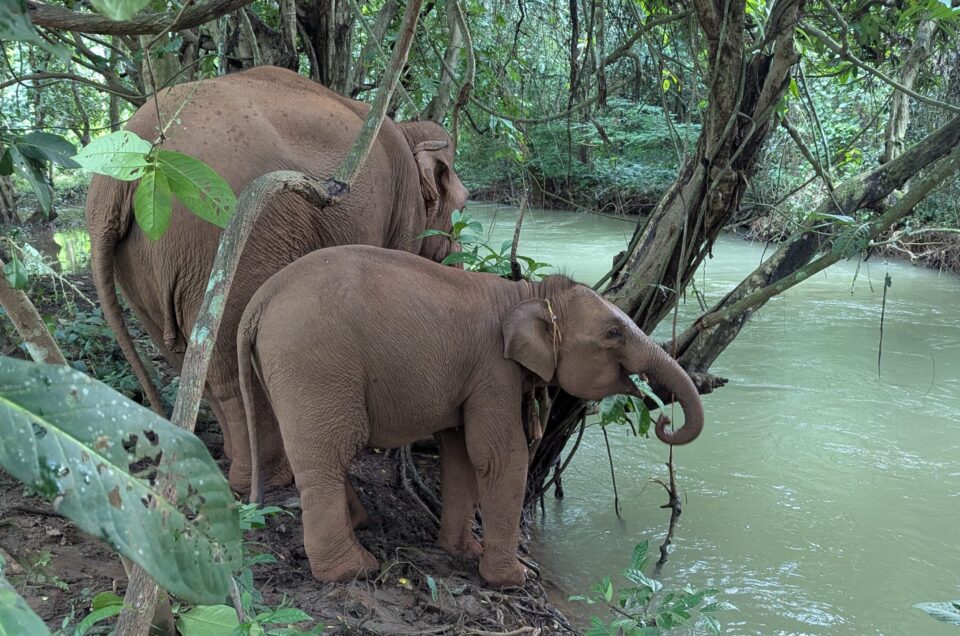
![[1] Q: Are Elephants in Tourism Wild or Domesticated?](https://manifatravel.com/wp-content/uploads/2023/03/elephant-vet4-780x636.jpg)
![[2] Q: Is elephant riding harmful?](https://manifatravel.com/wp-content/uploads/2021/10/IMG_5363-960x636.jpg)
![[3] Q: Is it ethical to chain elephants?](https://manifatravel.com/wp-content/uploads/2025/05/PXL_20220901_040409503.MP_-960x636.jpg)
![[4] Q: Is it important to use a hook with elephants?](https://manifatravel.com/wp-content/uploads/2025/05/PXL_20220901_024820365-960x636.jpg)
![[5] Q: How are elephants trained to interact with humans?](https://manifatravel.com/wp-content/uploads/2022/07/h-elp-luang-prabang-workshop-960x636.jpg)
![[6] Q: Should elephants working in camps be reintroduced into the wild?](https://manifatravel.com/wp-content/uploads/2025/05/PXL_20220901_030520392-960x636.jpg)
![[7] Q: Are elephants working for people eligible for rescue and conservation?](https://manifatravel.com/wp-content/uploads/2023/05/DSC_5581-960x636.jpg)